Tuesday, October 11, 2022

✨ Big influence

October 11, 2022 View online | Sign up
Finny
Gist
TOGETHER WITH Finny

Good day. If you're a homeowner and thinking about selling your home, painting your front door a particular color could add up to $6,500 to your house value, according to real estate experts. Can you guess what color that is? a. red, b. indigo, c. black. Follow the wave 🌊 below for the answer.

Today's money topics are:

  • The pension fund problem
  • Home builders are selling in bulk
  • Keeping financial secrets    

ECONOMY

The Pension Fund Problem

The UK just put on our closing act of Q3, and unfortunately, the curtains of an already grim quarter were closed on an ominous note.

What happened?

  • The British bond market along with the Pound took a precipitous tumble to close out September. Triggered by surprise news of unfunded tax cuts, this announcement spooked markets into widespread selling as prominent pension funds in the UK began falling prey to margin calls.
  • Why? Pension funds use what’s known as a liability-driven investment strategy (LDI) to ensure they can pay retirees. These strategies involve holding stocks, bonds, alternatives, and derivatives in enough quantity such that their value matches the fund’s liabilities — what they owe retirees. Funds have to post cash as collateral against their holdings, and the amounts fluctuate with the value of their assets. 
  • Bailouts: So, when the bond market plummeted, pension managers needed to post a lot more cash and fast. As a result, the Bank of England decided to go against the grain on its monetary tightening path, buying millions of pounds of bonds in this temporary rescue mission.

Why we’re concerned

Pension funds are big players with a big influence in the markets. The exact numbers are unclear, but we know these funds own and weigh on large swaths of both the stock and bond markets, meaning what happens to them matters to us. 

Watching something like this unfold across the pond sends a warning signal to the rest of the world, and the US is no exception with data pointing to dropping asset values across funds, and subsequently declining funded ratios too. 

Ultimately, all of this serves as yet another reminder that we’re still surfing the ripples of the pandemic and all of its economic side effects years later. It won’t be as straight of a path back to “normal” as we had hoped.

Take this related lesson on this topic and earn Dibs 🟡 while you're at it:

HOUSING

Home Builders Are Selling in Bulk

After setting the woods on fire for over two years now, the housing market saw average home prices surge over 40% during that time. Fueled largely by bidding wars and a fervent demand outstripping the supply, we’re only now seeing some relief. 

Cooling off

  • Demand drop: Demand elasticity is finally back in the housing market this year. August marked the 7th straight month we watched existing home sales decline — the longest-tenured slump since 2007. Sales were down 0.4% month-to-month and almost 20% year-over-year.
  • Rates hurt too: Every purchase comes with a cost-benefit analysis, and homes are no exception. With rates topping 15-year highs and pushing 7%, it just got a lot more expensive to buy a home. A 30-year mortgage on a $400K house would’ve cost about $1,940 per month back in early 2020, but now that number is more like $2,568, and over $220K in extra interest over the life of the loan.

But at what cost?

  • More inventory, more problems: We had 14% more homes under construction this August compared to last year. Elsewhere, the median days on the market for any given home has been rising since July, and our monthly supply of new houses is at its highest peak since 2010. 
  • Falling into the wrong hands: With many families being pushed out of the market by rising rates, home builders are having a tougher time selling properties, and as a result, they’re offering them in bulk to investors at a discount. Inventory is blooming and demand is drying, but families might not be the ones getting a break.

Taking a step back

These happenings shouldn’t come as a revelation to us, and it’s a natural course of action for both parties involved to take. 

It doesn’t mean the end is nye and all homes will soon be owned by giant real estate investors, but it does have the potential to somewhat complicate, and prolong, the cooling off that both homebuyers and renters are desperately hoping for.

Take this related lesson on this topic and earn Dibs 🟡 while you're at it:

FEATURING FINMASTERS

A Dollar-a-Day: Understanding The Power of Compounding Interest

One of the best things you can do in investing is to invest consistently—put some money into the stock market every day or every month.

Many have struggled to understand this concept, so that’s why the team at FinMasters came up with an illustrative calculator called a Dollar-a-Day. This calculator allows you to visualize the return you’d be generating had you consistently invested a dollar each day since your birth date. 

Dollar-a-Day illustrates the power of compounding interest—a key rule in investing. Some people call it math magic.

You can use this calculator to show your family and friends that investing a small chunk of money every day can help you build a fortune over time. In fact, that’s how many people get rich.

Check out Dollar-a-Day by FinMasters. It’s fun, educational, and free.

LOVE & MONEY

Keeping Financial Secrets

For better and for worse, money is an integral part of our modern way of life and is ultimately necessary to help facilitate the world as we know it. However, that can also cause problems too, as money’s importance means it both gives and takes away depending on our relationship with it. 

It’s the number one cause of divorce, and undoubtedly a common pain point of arguments too. Much of these situations arise from a lack of healthy communication though, especially when we keep secrets. 

A recent survey shed some real light on this

  • Good with the bad: It’s inevitable for money to come up at some point, but how we talk about it matters. The data shows that 83% of American couples do talk about money, but only 10% say they’ve never had a conflict over it, 20% are afraid to discuss it for fear of starting one, and 50% said they had kept financial secrets from their partner. 
  • How it’s divided: 46.3% of couples surveyed said they managed their money together whereas about 31% did so separately. The number of couples managing their money together increased to 66% among married people, but a popular alternative was a combination of the two, which also accounted for 22.8%. 
  • Money reveals things: About 15% of survey participants found some degree of difficulty to discuss finances with their partner. Similarly, about 15% of respondents also said talking about money had a negative impact on their relationship, pointing to some differences that should be addressed.  

Our take

In most cases, making money work together for both parties is a requirement for making the relationship work. Talking about money can reveal differences, and it opens the door to reconciling them. 

Even if you find that talking about money has no significant impact on your relationship dynamics, it’s probably still a positive thing to do.

🔥 TODAY'S MOVERS & SHAKERS

  • LYFT (-10.3%) and Uber (-8.5%)—both ride-hailing apps—are lower today on reports that the US Department of Labor (DOL) will soon release a proposal to make companies reclassify independent contractors as employees.
  • Weber (+12%) as shares of the US manufacturer of outdoor grills and accessories are higher on no new reports today and on the heels of USB's report that the stock poses downside risk.
  • S&P 500 Index (-0.3%) to $3,599.49 (1D)
  • Bitcoin (-0.2%) to $19,095.10 (1D)
  • Ethereum (-0.3%) to $1,287.58 (1D)

This commentary is as of 8:30 am PDT. 

🌊 BY THE WAY

  • ◼️ Answer: Black. If you're researching 'what adds the most curb appeal,' you are likely to hear a lot about the power of a front door. A black front door can simultaneously improve your curb appeal – and your house value ($900 - $6,500 more than similar homes in the area), according to Kerry Sherin, a consumer advocate at home valuation company, Ownerly (Homes & Gardens)
  • 📱 Parental tech support: everything you should fix on a senior’s phone (Washington Post)
  • 👍 ICYMI. The 28/36 mortgage rule of thumb (Finny)
  • 📦 Amazon Prime Day: what to expect from the Early Access Sale (Yahoo Finance)
  • 🎢 iPhone 14 crash detection feature reportedly dials 911 from roller coasters (Fox Business)
  • 💰 Finny lesson of the day. As we settle into Q4 and look back at our losses and gains this year, refresh yourself with some of the special US rules for taxing capital gains and losses:

Finny is a financial wellness platform on a mission to make your money work for you. The Gist is Finny's twice-a-week (Tues & Thurs) newsletter covering personal finance & investing insights and money trends. The content team: Austin Payne, Carla Olson, Chihee Kim. Finny does not offer investment and stock advice.

We're thankful for the support of today's sponsor & partner⁠—Finmasters—as they make rewards on our platform possible. If you're interested in sponsoring The Gist, please reach out to us. And if you have any feedback for us, please contact us

© Finny 2022. All rights reserved.
736 Paloma Ave, Burlingame CA 94010

Thursday, October 6, 2022

🚦 Do not enter

October 06, 2022 View online | Sign up
Finny
Gist
TOGETHER WITH Finny

Good Thursday to you. Can you guess what FICO credit score usually will get you the best loan rates in the US? (FICO scores range from 300 to 850.) a. 680, b. 760, c. 830. Follow the wave 🌊 below for the answer.

Today's finance & investing topics are:

  • The stock market isn't taking new applicants
  • What's a home purchase cancellation?
  • The 28/36 mortgage rule  

MARKET OUTLOOK

The Stock Market Isn't Taking New Applicants

In 2021, companies in the US raised over $155B in funding from their public offerings. Now, money is scared and businesses are apprehensive. Having raised just $7.2B this year with 159 IPOs, the stock market is on pace for its lowest number of new entrants since 2016.   

The IPO reckoning

  • The culling: We set IPO records in both 2020 and 2021. With a new high of 480 notched in 2020, last year smashed this record with 1,035 newly listed companies. That rapid expansion has cooled just as fast, and we’re on pace for a 79% decline from 2021. 
  • Do not enter: The market has hung its hurricane flags to warn potential suitors of the danger that could befall them if they venture in. About 87% of businesses that went public last year are down, and most of them are down tremendously — the average loss is almost 50%. 
  • Patience makes perfect: Hundreds of companies have either abandoned or postponed their IPO plans, with many taking it month by month. Others with enough interest and cachet like Klarna have relegated themselves to private equity for now, which is also downtrodden.

The bigger picture

The reality is that this isn’t anything new. We only saw 47 IPOs back in 2008 during the financial crisis when the S&P 500 fell over 30% that year; it’s entirely normal for businesses to retreat when the market is suffering. 

Things like this hurt retail traders buying individual stocks the most though, and serve as a reminder to invest, and speculate, with caution — especially during tumultuous times like this.

HOUSING

What's a Home Purchase Cancellation?

Giphy

Fresh data points out that around 72% of recent homebuyers who purchased within the last couple of years are now regretting their decision. The reasons vary from home cost to feeling rushed, but the end result is remorse. 

This has bled into the number of purchase cancellations we’ve seen recently too, with 15.2% of contracts being canceled in August — up from 12.1% a year ago. It’s better to change your mind about a home sooner than later, for sure. However, there are some things to know first. 

FYI — Home purchase cancellations

  • Canceling risks: Homebuyers are usually required to put down some earnest money upon agreeing to purchase, usually 1% to 5% of the home price. If you choose to cancel, you might risk losing this earnest money and anything else you’ve spent so far if the cancellation isn’t warranted by unmet contingencies. 
  • Leverage contingencies: Contingencies are items specified in your purchase agreement that must be met for the contract to bind. These are things like your financing, appraisal, home inspections, title search, and other requests that either party can make. If you think cancellation is possible, avoid compromising on contingencies, and use them to your advantage — unmet contingencies provide a valid cancellation request and shouldn’t lose your earnest money. 
  • Proceed with caution: Ultimately, the best thing any homebuyer can do is take the time to carefully consider their options and eventual decision to buy. If there are potential threats to your purchase on the horizon, make an effort to accommodate those in your contingency requests.

Take this related lesson on this topic and earn Dibs 🟡 while you're at it:

TOGETHER WITH THE DAILY VALET.

Get Ready To Be More Interesting

There's so much going on these days, it's hard to know what's worthy of your attention. The Daily Valet. is your inside track to what's happening, what's cool and the events to keep on your radar. 

They cover news, guidance and the latest product recommendations from their editors, all in a handy, 5-minute read that ends with a shot of daily inspiration. It’s as enlightening as it is entertaining. Readers are saying “it’s an essential morning read that spans lots of different interests.”

Think of The Daily Valet. as your cheat sheet to what you need to know about right now. Never walk into a meeting or after-hours drinks and feel caught off guard again. 

Subscribe for free.👉

MONEY TIP

The 28/36 Mortgage Rule

There’s a limitless number of “rules of thumb” out there in the world of personal finance. The reality is that everyone’s exact ratios will be a little different, but these rules can be great guidelines to follow anyway, nudging us in the proper direction. 

Continuing in the spirit of homeownership, let’s zoom in on another mortgage-related rule, the 28/36 rule. 

The ins and outs 

  • 28/36 overview: The 28/36 rule simply suggests that a borrower shouldn’t use more than 28% of their gross monthly income on housing expenses, and no more than 36% toward total debt servicing. 
  • Put into practice: Let’s say you make $5K per month. That means you’d ideally spend no more than $1,400 a month on housing, and no more than $1,800 on debt including housing. 
  • The reasoning: This rule combines both your housing costs and total debt obligations because your debt-to-income ratio (DTI) is very important to lenders, and an indicator of how likely you are to meet payment obligations. It’s possible to exceed this “ideal” ratio, but the higher you go the higher your interest rate will be.

Take this related lesson on this topic and earn Dibs 🟡 while you're at it:

🔥 TODAY'S MOVERS & SHAKERS

  • Li Auto (-11.5%) despite no new announcements today; last week however, the Chinese EV maker cut its Q3 delivery guidance by 2,500 vehicles or 9% on supply chain constraints.
  • McCormick (-1%) as quarterly earnings were lower than the street's estimate (revenue was in-line); the spice maker said that expenses outpaced product price increases and that it was now recovering costs through pricing actions.
  • S&P 500 Index (-0.4%) to $3,769.91 (1D)
  • Nasdaq Composite (-0.2%) to $11,132.32 (1D)
  • Bitcoin (-0.5%) to $20,070.80 (1D)
  • Ethereum (+0.9%) to $1,364.85 (1D)

This commentary is as of 8:40 am PDT. 

🌊 BY THE WAY

  • ✨ Answer: 760 is the magic number“The best published interest rates for auto loans are 720+ and for mortgages 760+,” says financial expert John Ulzheimer, formerly of FICO and Equifax (CNBC)
  • 🛒 Walmart is holding a “Rollbacks and More” sale event to counter Amazon’s Prime Early Access Sale. It'll start on October 10 at 5am EDT and end on the 13th (TechCrunch)
  • 🥴 ICYMI. Homebuyer’s remorse: why recent homebuyers are regretful (Finny)
  • ⤵️ Mortgage applications plummet 14% as higher interest rates and Hurricane Ian crush demand (CNBC)
  • 🍻 The #1 perk that will bring Gen Z and millennials into the office (CNBC)
  • 🎯 Finny lesson of the day. With rates going up, the difference between a good credit score and a fair one can mean thousands of dollars of savings, depending on our purchase. Here's a refresher on some basics:

Finny is a financial wellness platform on a mission to make your money work for you. The Gist is Finny's twice-a-week (Tues & Thurs) newsletter covering personal finance & investing insights and money trends. The content team: Austin PayneCarla OlsonChihee Kim. Finny does not offer investment and stock advice.

We're thankful for the support of today's sponsor & partner⁠—The Daily Valet.—as they make rewards on our platform possible. If you're interested in sponsoring The Gist, please reach out to us. And if you have any feedback for us, please contact us.

© Finny 2022. All rights reserved.
736 Paloma Ave, Burlingame CA 94010

Tuesday, October 4, 2022

🎢 Out of style

October 04, 2022 View online | Sign up
Finny
Gist
TOGETHER WITH Finny

Good day. Based on a recent survey, can you guess which of the following expenses is contributing the most to credit card holders who carry a balance? a. day-to-day expenses like groceries, b. retail purchases like clothes, c.  emergency expenses like a car repair. Follow the wave 🌊 below for the answer.

Today's finance & investing topics are:

  • Growth fears return
  • Volatility is out of style 
  • It’s FAFSA time again

ECONOMY

Growth Fears Return

The markets have been pounded by heaps of disparaging news over the last several weeks. Preceded by news of a consecutive quarterly decline in US GDP, more data has since piled up, indicating that this growth slump might be more than just a blip.  

The culprits — bears of bad news

  • Resilient inflation: July’s inflation report gave us a little hope, August’s let us down, and it presently appears that it might not drop as quickly as we previously hoped. Inflation is stiff elsewhere too, with the UK logging 9.9% in August’s report while Canada notched 7%, Mexico 8.7%, India, 7.6%, and Germany 7.9%. 
  • Aggressive central banks: Inflation is stubborn, but so is the Fed, and central banks around the world are willing to play chicken with rising costs and see who folds first. The US Fed reinforced its stiff posture on inflation, noting that “no one knows if there will be a recession or how severe and that achieving a soft landing was always difficult." Other central banks across the world have followed suit. 
  • The dollar's growing strength: The dollar continues to rise, and is now up over 21% over the last year. While that might seem like a positive, it creates a drag on both the domestic and global economy when it's exacerbated. USD’s strength is dampening profits, exports, and potentially other economies too. 
  • An overall slowdown globally: US GDP has declined through the first two quarters of 2022, Europe underwent a sharp decline in activity last month after also posting lower GDP numbers, and a large swath of developed nations have lost some momentum in the wake of war, inflation, and reactionary monetary policy.

Where’s the light?

All of this has thrown the global economy into a disarray of sorts. As a result, the Organisation for Economic Co-operation and Development (OECD) has reigned in global growth estimates to 3% this year, further dropping to 2.3% in 2023. 

All of this leaves us with more questions than answers, and the one thing that’s certain right now is uncertainty as the world tries to correct its elongated tailspin that started back in 2020.

Take this related lesson on this topic and earn Dibs 🟡 while you're at it:

INVESTING

Volatility is Out of Style

Volatility has entered the limelight over the last 24 months as meme stocks and retail traders took the markets on a wild ride. And it’s still here too, with the volatility index ($VIX) sustaining its heightened levels all year. 

Despite the bumpy ride, volatility is falling a bit out of favor. Investors are tired of the roller coaster and just want a little safety nowadays. 

Watch the money

  • Shelter from the waves: Our most recent data shows that $6.5B has flowed into low volatility funds thus far in 2022, putting them on track to log their first net inflow since 2019. Despite their lackluster performance in 2020, it’s easy to see why investors and money managers are giving them another chance. 
  • What are these LV funds? Low volatility funds are at their best when markets are at their worst. Their holdings and the weight of those holdings are designed to mitigate volatility and give investors a smoother ride over rough terrain. Think of them as the Cadillac of ETFs. 
  • The downside: It’s hard to have your cake and eat it too. Although these funds protect against big volatility waves, they’ll also leave investors out of bull runs. Between June 2020 and December 31st, 2021 when the S&P rose 49%, the top min vol fund by assets, the iShares MSCI USA Min Vol Factor ETF ($USMV), climbed about 27%, lagging the market by 22%. 
  • Their resolve: The inverse is also true. While the S&P has fallen almost 10% in the last month, $USMV and others (depending on their holdings) have dipped about 8%. Over a longer span, the S&P has fallen 20% this year, while low volatility funds like this one have fallen 13%.

Peaking ahead 

Is this “bullish” for these kinds of funds? Not really, more like less bearish. But hey, losing by 10 is better than losing by 50.  

Going forward, we can reasonably expect this level of volatility to continue, making it likely these funds will continue to rake in new cash at least for the remainder of the year.

Take this related lesson on this topic and earn Dibs 🟡 while you're at it:

TOGETHER WITH ON DECK

Join The Most Helpful Operator Angels Around The World

On Deck Angels (ODA) is a continuous community for the world’s most helpful operator angels. 

Kickstarting with an 8-week immersive onboarding, they combine a world-class curriculum, exclusive deal flow and an incredible network of peers to help you win deals, define your investing craft and build long-lasting relationships in the ecosystem.

ODA will help you meet your angel investing goals whether you’re just getting started, a prolific angel investor or an emerging fund manager. 

Here’s what Caroline Gash (Early-stage investor and operator) had to share about her ODA experience:

I came to ODA because I was looking for the peer group to grow the next ten years of my career with.

As investors we can become really siloed and function in echo chambers. I strongly believe that having diverse opinions, geographic regions, industries makes us all stronger in investing and that was a core set of ODA.

To join the next cohort, apply by October 9. Limited spots available.

MONEY TIP

It’s FAFSA Time Again

Filling out a FAFSA isn’t a requirement for attending university, but it certainly could make it a lot cheaper. Sure, it might seem a little intimidating and intrusive on the surface, but once you get the hang of it, this annual process becomes much easier. 

Filling out your FAFSA form could get you access to potentially thousands in dollars of aid — and that’s life-changing for anyone. The application period for the 2022-23 school year opened on October 1st, and it’s best to get started early. 

What to know this year

  • You likely qualify for aid: Data from 2020 shows that about 85% of undergraduates received financial aid. Even if you think you might not qualify, there’s a good chance you do. The formula for calculating this is a little complex, but it takes into account more than just income.
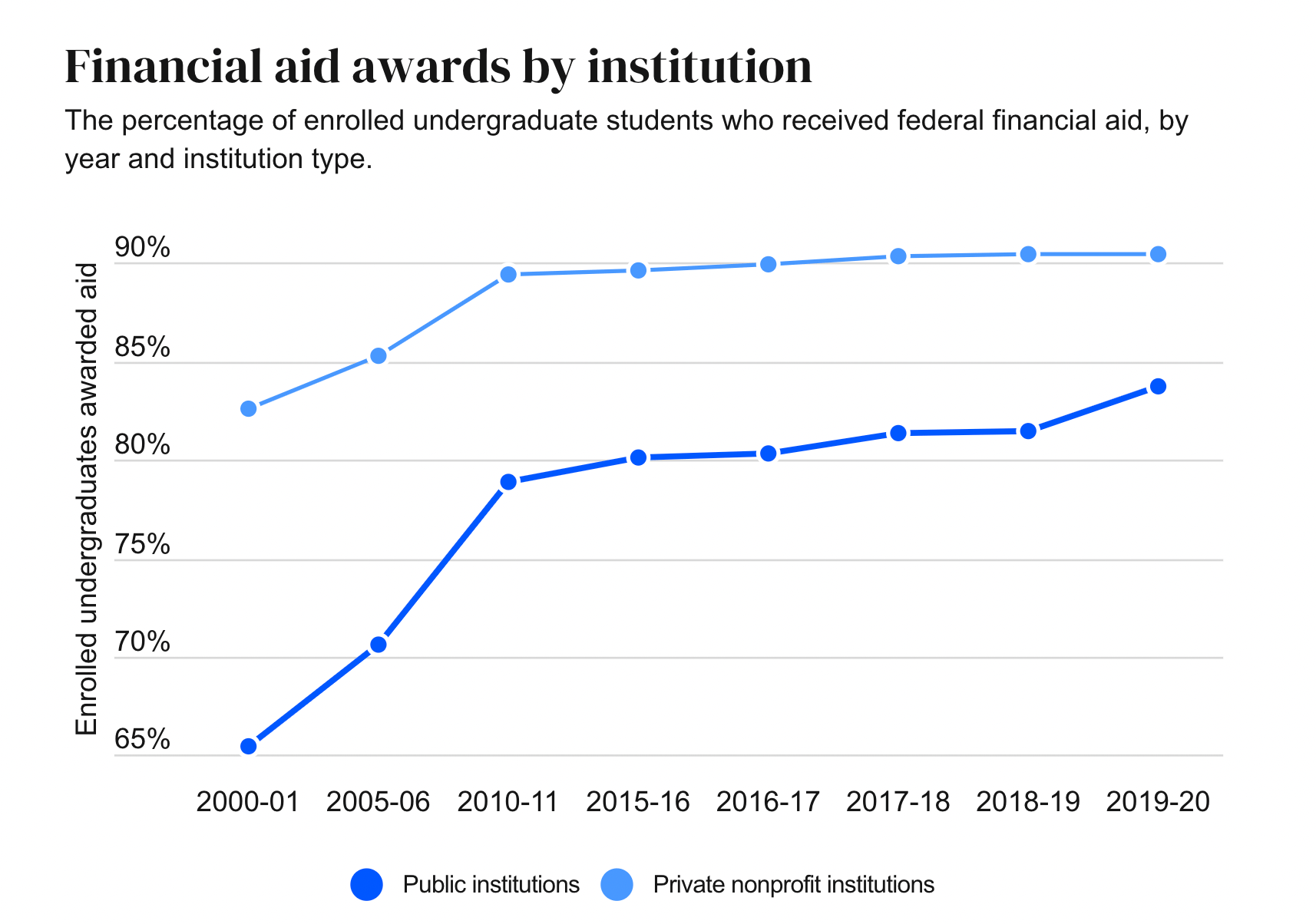
Annual data not available before 2015.

Source: National Center for Education Statistics

  • If you need a student loan, you need a FAFSA. Students applying for a Federal loan are required to fill out a FAFSA form even if they’re not eligible or applying for financial aid, and doing so is worth it. If taking out a loan, Federal student loans usually offer much lower interest rates compared with private lenders, plus, they allow the option of securing a subsidized student loan too, which doesn’t accrue interest during school. 
  • Otherwise, still do it: Even for students who don’t plan on taking out a loan, FAFSA can still be important to you because many universities use this information in conjunction with their own to determine the awards and compensation they give out.

Take this related lesson on this topic and earn Dibs 🟡 while you're at it:

🔥 TODAY'S MOVERS & SHAKERS

  • Peloton (+15.3%) on yesterday's news that the company will put bikes in all 5,400 Hilton-branded US hotels in the U.S. The partnership includes all 18 of Hilton's subsidiaries, including Hampton Inn and Doubletree.
  • Poshmark (+13.3%) following news that Naver, a South Korean internet company, will buy the online retail site for $1.2B in an all-cash deal.
  • S&P 500 Index (+2.9%) to $3,785.17 (1D)
  • Bitcoin (+1.9%) to $20,001.00 (1D)
  • Ethereum (+1.9%) to $1,349.05 (1D)

This commentary is as of 8:30 am PDT. 

🌊 BY THE WAY

  • 🚨 Answer: emergency expenses came out on top with 46% of respondents saying they’re carrying a balance because of an emergency expense like a car or home repair; 24% said it's due to everyday expenses like groceries and 11% pointed to retail purchases as their main reason (CNBC
  • 🛒 Amazon debuts new shopping portal for customers on government assistance (CNN)
  • 📈 ICYMI. Relief rallies in a bear market (Finny)
  • 🚀 Turkey’s inflation hits 83% as Erdogan vows to keep cutting interest rates (CNBC)
  • 🏠 Arrived makes it easy to buy shares of rental homes, allowing anyone to earn passive income starting with $100. Real estate investment returns have proven to be remarkably stable over time and are a great hedge against stock market fluctuations. View available investment properties (Arrived)
  • 🚝 These 3 European countries will soon be linked to the rest of Europe via high-speed rail (Travel Awaits)
  • ☔ Finny lesson of the day. If you haven't yet started to save up for your emergency savings, get started by going through this bite-sized learning on the topic:

Finny is a financial wellness platform on a mission to make your money work for you. The Gist is Finny's twice-a-week (Tues & Thurs) newsletter covering personal finance & investing insights and money trends. The content team: Austin PayneCarla OlsonChihee Kim. Finny does not offer investment and stock advice.

We're thankful for the support of today's sponsor & partner⁠—On Deck, Arrived—as they make rewards on our platform possible. If you're interested in sponsoring The Gist, please reach out to us. And if you have any feedback for us, please contact us.

© Finny 2022. All rights reserved.
736 Paloma Ave, Burlingame CA 94010