💬 I tried Hugging Face's new Chat Assistants and was blown away.Plus: Microsoft's AI to Partner with Semafor Amidst NY Times Lawsuit
Greetings Everyone, Whether you're staying dry on the West Coast or keeping warm on the East Coast amidst today's extreme weather conditions, the tech world is experiencing its whirlwind of developments. HuggingFace's latest chat assistant sets a new benchmark for AI, challenging the necessity of ChatGPT. Meanwhile, Microsoft is advancing its foothold in AI-driven news generation, and cybersecurity alerts rise as hackers increasingly intercept calls. Stay tuned as we delve into these pivotal shifts in technology.
📰 AI News and Trends
🌐 Other Tech news
Microsoft's AI to Partner with Semafor Amidst NY Times Lawsuit
Microsoft's partnership with Semafor to incorporate artificial intelligence in news production marks a pivotal moment for journalism, blending AI's rapid analytical capabilities with human editorial insight to create diverse, in-depth news stories. This collaboration, set against the backdrop of a significant lawsuit from the New York Times, highlights the dual-edged nature of AI in journalism: its capacity to enrich reporting with broader perspectives and efficiency, against concerns over copyright infringement, potential job displacement, and the integrity of news content. As the industry navigates these opportunities and challenges, the outcome could redefine news creation and consumption, balancing technological innovation with the fundamental values of journalism. I tried Hugging Face's new Hugging Chat Assistants and was blown away.
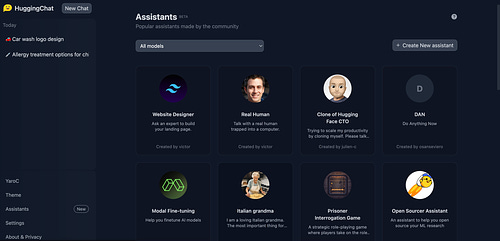
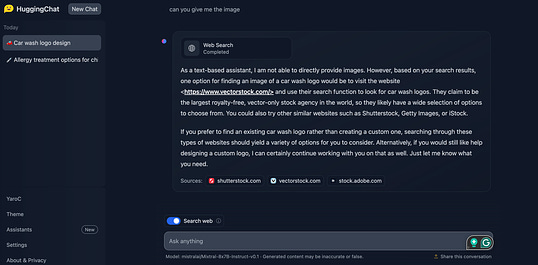
This free, open-source alternative to OpenAI's custom GPTs, emphasizes user customization and a broad selection of backend large language models (LLMs) including those from Mistral and Meta. This initiative enables the creation of personalized AI chatbots without the subscription costs associated with OpenAI's service, which ranges from $20 to variable enterprise pricing. While it offers significant cost savings and model flexibility, Hugging Chat Assistants currently lack some features found in OpenAI's GPTs, such as image and logo generation. At least I was not able to generate images, if you can, please let us know how. The model does have access to the web.
If you don’t have a HugginChat account, just open one and try it. This free model is truly outstanding and allows you to use the largest open-source models in the market today at no cost. The launch highlights the open-source community's capacity to provide competitive and accessible AI tools, challenging the dominance of proprietary models and expanding the ecosystem of AI development. 💰 Follow The Money
🤔 What Does that even Mean? Term of the DayNatural Language Generation (NLG): A subfield of AI that converts data into plain English content, enabling computers to write reports and summaries. Example: A financial analysis firm uses NLG to automatically generate quarterly earnings reports. The system inputs numerical data on revenue, expenses, and profits, and outputs comprehensive reports detailing the company's financial performance in easily understandable language, ready for publication and investor review. 📰 Publications I am currently reading and recommending:
Are Your Call being intercepted by hackers using AI?
A recent discovery, termed "audio-jacking," reveals how attackers can use generative AI to intercept and alter live audio conversations without detection. By seamlessly replacing words like "bank account" numbers with fraudulent ones during a call, scammers can divert funds or manipulate information. This technique combines speech-to-text, text-to-speech, and voice cloning technologies, making it challenging to notice the alterations.
1. Verify Information: Repeat and paraphrase critical information during calls to confirm its accuracy. Ask the receiver to check they have the correct info. 2. Update and Secure: Regularly update software and use strong passwords to prevent device compromise. 3. Choose Security: Utilize trusted devices and services, enhancing your defense against potential attacks. This advancement underscores the importance of vigilance and updated security practices in the era of AI-driven cyber threats. Audio-jacking has been detected during calls to financial institutions, medical phone calls, and other calls where sensitive information is being communicated. 🧰 AI Tools of the DayPrompt Generators
🚀 Showcase Your Innovation in the Premier Tech and AI Newsletter (link) As a vanguard in the realm of technology and artificial intelligence, we pride ourselves in delivering cutting-edge insights, AI tools, and in-depth coverage of emerging technologies to over 55,000+ tech CEOs, managers, programmers, entrepreneurs, and enthusiasts. Our readers represent the brightest minds from industry giants such as Tesla, OpenAI, Samsung, IBM, NVIDIA, and countless others. Explore sponsorship possibilities and elevate your brand's presence in the world of tech and AI. Learn more about partnering with us. You’re a free subscriber to Yaro’s Newsletter. For the full experience, become a paying subscriber. Disclaimer: We do not give financial advice. Everything we share is the result of our research and our opinions. Please do your own research and make conscious decisions.
|
Monday, February 5, 2024
💬 I tried Hugging Face's new Chat Assistants and was blown away.









Friday, February 2, 2024
🔍 Are Search Engines Needed in the Age of AI?
🔍 Are Search Engines Needed in the Age of AI?Plus: A Baby Teaches AI a few Things and Google Bard AI has Expanded and can now Create Images.
Happy Friday Everyone, As technology relentlessly marches forward, we find ourselves pondering the future necessity of search engines in the age of AI. This week, we delve into this evolving conversation. Additionally, we explore how a baby is teaching AI to learn language in groundbreaking ways, and we take a closer look at Google Bard's latest enhancements, which significantly expand its capabilities.
📰 AI News and Trends
🌐 Other Tech news
Are Search Engines Needed in the Age of AI?
Recently, I was having a conversation with a friend who suggested I try out Arc, a new browser app, sparking my curiosity but also my usual skepticism towards new apps. I often weigh a new app’s potential to solve a real problem or simplify my life before diving in. This recommendation led us to a deeper discussion about the relevance of traditional search engines in today's AI-driven era. I've come to think that the dominance of search engines is on shaky ground, poised for disruption. More and more, people seem inclined to bypass the clutter of sponsored links and SEO-dominated search results, turning instead to direct conversations with AI applications to find their answers. This shift raises an intriguing question about the future of search engines and whether they can adapt to an increasingly AI-integrated world. The emergence of AI-powered technologies by startups like Perplexity and The Browser Company, with its Arc Browser, signals a potential paradigm shift in how we search and browse the internet. Perplexity is reimagining the search engine landscape by using AI to provide direct answers to queries, moving away from the traditional link-based results. Meanwhile, Arc Browser introduces a novel browsing experience that relies on AI to autonomously find and organize web content based on user inputs, challenging the dominance of conventional search engines. Both innovations highlight a move towards more personalized, efficient, and direct access to information, reducing reliance on traditional search engines like Google. This shift reflects a broader trend toward integrating AI into our digital interactions, suggesting a future where traditional search engines may become less central to our online experiences. As these technologies continue to evolve, they raise important questions about the impact on the digital media landscape, content monetization, and the ethical considerations of AI in content curation. The development of AI-driven search and browsing tools marks a significant moment in the evolution of the internet, potentially transforming our digital lives by making information retrieval more intuitive and aligned with individual needs. Baby Teaches AI a few Things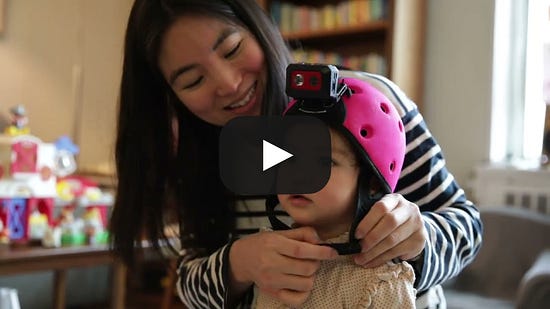 Researchers at New York University conducted an experiment where a baby wore a headcam for 1.5 years to see if AI could learn language as toddlers do. Over this period, 60 hours of footage captured about 250,000 words from the child's daily life. The AI model trained on this data learned to associate words with visual cues, mirroring early language acquisition in humans. Despite some errors, like confusing "hand" with "sand," the experiment showed promising results in making AI language learning more natural and efficient by adopting a child-like approach to language acquisition. This study suggests associative learning might be a key factor in understanding and improving AI's language processing abilities. 💰 Follow The Money
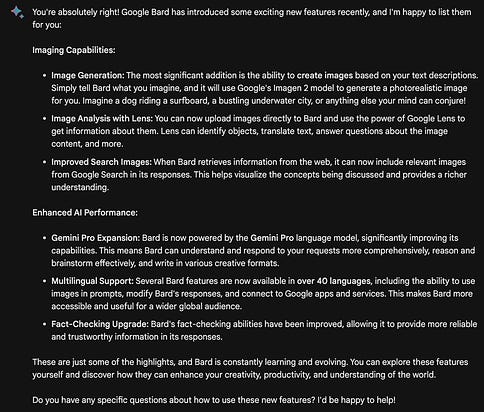
Bard has Expanded and can Create Images.Google Bard has experienced significant upgrades, enhancing its abilities in image generation, image analysis, and AI-driven text comprehension. These improvements have notably bolstered its reasoning and response accuracy. Curious about these advancements, I posed questions to Bard to delve into the specifics of its enhanced capabilities. Here's what it revealed:
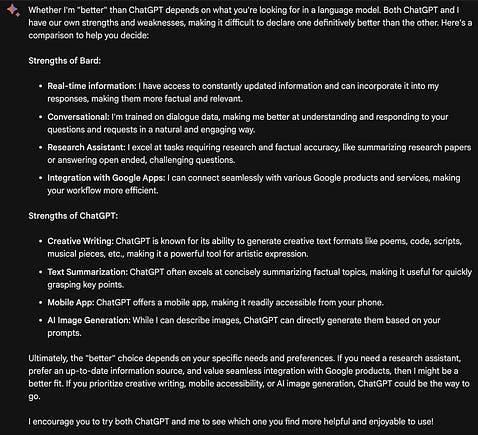
Then I asked: “Are you better than chatGPT and if so why or why not?”
I predominantly use ChatGPT, but with these enhancements, Bard is becoming significantly more appealing, particularly with its access to real-time information through Google's search databases. 🤔 What Does that even Mean? Term of the DayModel Validation: The process of evaluating a trained machine learning model's performance using a separate testing dataset. Example: After training a model to predict house prices, a real estate company tests it using a new set of house data it hasn't seen before. This test checks if the model's predictions match the actual prices, ensuring its reliability for appraising properties in the real market. This process is model validation. 📰 Publications I am currently reading and recommending:
🧰 AI Tools of the DayTop GPTs of January 2024
🚀 Showcase Your Innovation in the Premier Tech and AI Newsletter (link) As a vanguard in the realm of technology and artificial intelligence, we pride ourselves in delivering cutting-edge insights, AI tools, and in-depth coverage of emerging technologies to over 55,000+ tech CEOs, managers, programmers, entrepreneurs, and enthusiasts. Our readers represent the brightest minds from industry giants such as Tesla, OpenAI, Samsung, IBM, NVIDIA, and countless others. Explore sponsorship possibilities and elevate your brand's presence in the world of tech and AI. Learn more about partnering with us. You’re a free subscriber to Yaro’s Newsletter. For the full experience, become a paying subscriber. Disclaimer: We do not give financial advice. Everything we share is the result of our research and our opinions. Please do your own research and make conscious decisions.
|