Thursday, September 15, 2022

✨ It's not all bad

September 15, 2022 View online | Sign up
Finny
Gist
TOGETHER WITH Finny

Good day. Can you guess how many of the roughly 500 companies in the S&P 500 index cited the term “recession” in their Q2 earnings calls? a. 140, b. 240, c. 340. Follow the wave 🌊 below for the answer. 

Here are today's money topics:

  • The state of the 60/40 portfolio
  • Retail traders have lost some power
  • Take advantage of all your employee benefits

INVESTING

The State of The 60/40 Portfolio

The 60/40 portfolio holds 60% stocks and 40% bonds. The concept was coined by Vanguard’s founder, John Bogle, and has been considered a tried and true allocation for many decades now. 

The reasons for its existence come down to simplicity, reliability, and good returns. It’s a more extreme example of something like the rule of 110, which says your equity allocation should be 110 minus your age. For example, if you’re 30 years old with a moderate risk profile, you would hold 80% in stocks or stock funds (110-30 years old = 80% stocks).

  • The returns speak for themselves. The main goal of a 60/40 portfolio is to reliably deliver average returns of around 7% annually. But this asset mix has actually averaged 8.8% between 1926 and 2021, 11.5% since the financial crisis, and generated positive returns in 35 out of the 42 years since 1980. Batting .833 ain’t too bad. 
  • But it has its haters: Despite having one of its worst years in a while, headlines claiming the 60/40 portfolio’s death have been vastly overstated. As of Sept. 7th, the portfolio’s return this year sits at a dismal -17.25%, but this down year doesn’t discount its viability going forward. 
  • A weird scenario: Alternatively, a portfolio allocated 100% to the total stock market would be down about 17.23% this year, which is quite literally no different. The problem is that bonds are usually expected to have an inverse relationship to stocks, and because of rising interest rates this year, the price of existing bonds has fallen, eliminating the 60/40 portfolio’s usual 40% bond hedge. 
  • All is not lost though: The 60/40 remains a classic, reliable default portfolio that we should reasonably expect to continue its relatively predictable performance going forward, even if it does have a blip like 2022 here and there. It’s not the gospel of investing though, and we should always use our risk tolerance, time horizons, and financial goals to arrive at the right allocations for ourselves.

Take this related lesson on this topic and earn Dibs 🟡 while you're at it:

MARKET OUTLOOK

Retail Traders Have Lost Some Power

The end of 2020 rolled seamlessly into 2021 with a common trend intact: Retail traders exerted a never before seen influence on the markets. 

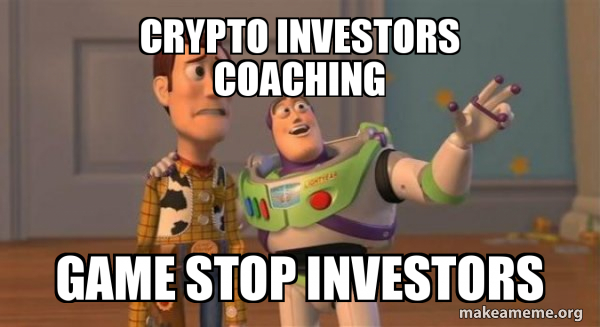
Between well-known escapades like Gamestop and tens of lesser-known meme stocks that retail traders turned into multi-baggers, these investors were throwing their weight around for once, to the point that the SEC even investigated it

But what goes up, must come down

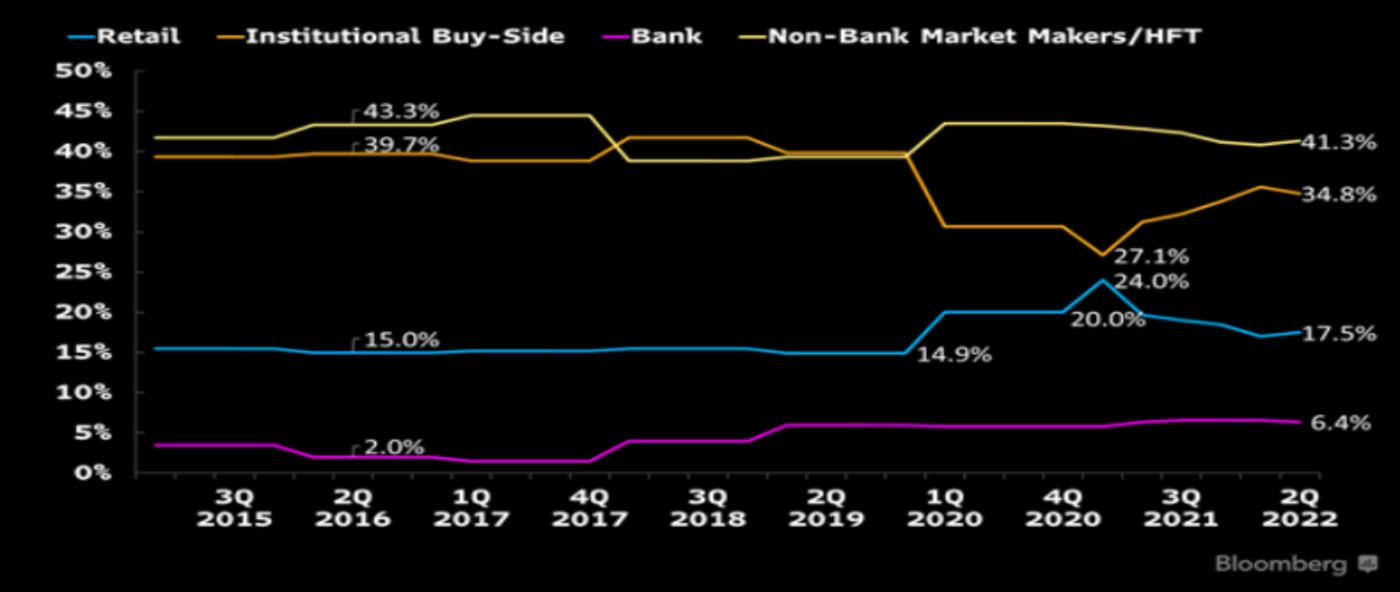
  • A measurable presence: The meme stock frenzy wasn’t just an anecdotal experience that was seen culturally, locally, or online, but in the numbers too. Retail traders made up 24% of all trading activity back in Q1 of 2021, an all-time high. 
  • Getting humbled: This was followed by a harsh drawdown in Q2 of last year that knocked retailers back, but the underlying effort was still there. Since then, trading volume consumed by individuals has dwindled, falling back to 17.5% by Q2 of 2022. 
  • A dragging trend: Meme stocks and the retail movement isn’t “dead” per se, but it is dragging. Despite a July/August bounce that did take some momentum plays with it, the overall trend is down. Trendy plays have fallen all around, and funds centered on this idea are hurting too, with popular ETF $MEME being down a whopping 53% YTD.

Trading volume breakdown by market participants

Source: Bloomberg Intelligence

It’s not all bad news though

Individual participants are still making up more of the market than ever, and a decline to 17.5% of transactions is still steadily above the 10-15% we’ve seen traditionally. 

Meme stocks are probably harmless, but we know they’re unsustainable. It’s all part of a broader shift toward giving individuals the power to play and taking the power out of the hands of those who were traditionally privy to the markets. Basically, we’re getting rid of the middlemen.

Take this related lesson on this topic and earn Dibs 🟡 while you're at it:

SPONSORED BY MASTERWORKS

Beat the “Decade of Lost Wealth” with One App

The stock market is down 20%, its worst first half since 1970. Inflation sits at 8.5%, its highest in 40 years. Now, economists say there's a 50% chance of a severe recession. How can you prepare?

For centuries, the ultra-wealthy have insulated their wealth through an exclusive, multi-trillion dollar, alternative asset: fine art. In fact, in the last quarter-century, contemporary art prices have outpaced the S&P 500 by a staggering 164%.

With Masterworks, everyday investors can now access the top-end of the art market by buying shares of iconic artworks by names like Picasso and Banksy. In their last 6 exits, Masterworks has realized an average net return of 29.0%*.

Due to record demand, shares of some paintings have sold out in just 14 minutes. But readers of The Gist can get in on the action by skipping the waitlist via this exclusive referral link.

WORK BENEFITS

Take Advantage of All Your Employee Benefits

High-quality employee benefits are something all of us long for when sorting through potential employers. And as we should, these add-ons can make a massive difference in our finances both long and short term. 

Unfortunately, sometimes we often take them for granted, overlook a couple, or simply don’t maximize the options offered to us. 

Tips to take full advantage

  • Max your match: If your employer offers a 401(k) match, taking advantage fully is the best thing you can do. It’s free money, after all. If you have a 50% on-the-dollar match for up to 6% of your $50k salary, that’s a potential extra $3k per year. If you only contribute 3%, you’re missing out on $1,500 every year, or $30,000 over 20 years. If you broke this extra cash down to investing $125 per month in an S&P fund, that would amount to $66,403 after just 20 years. Don't miss out on all that compounding, free money!
  • Schedule time to explore: Understanding all your benefits becomes increasingly important if your company offers many benefits. It’s a good problem to have, so taking the time to explore your HR portal or just talking with your HR department and reviewing your documents can go a long way and save you tons of money. 
  • Pricing benefits: Many employees will have an array of benefits and perks that are huge money savers. For example, you can get a full estate plan through a monthly legal subscription service, free or cheaper insurance services (i.e., group life, pet, etc.), and even access to a wide range of mental, health, and financial wellness services at no cost. 

🔥 TODAY'S MOVERS & SHAKERS

  • Adobe (-17.1%) shares fall on the announcement it will acquire design platform Figma for $20 billion in cash and stock. 
  • Store Capital Corp (+20%) on news that the REIT will be acquired by GIC, a global institutional investor, and funds managed by Oak Street in an all-cash transaction valued at approximately $14 billion.
  • Rail stocks are higher on reports of a tentative agreement preventing a rail workers' strike; Union Pacific (+2.4%), Norfolk Southern (+1.6%).
  • Wynn Resorts (+8.7%) as its stock was upgraded by Credit Suisse,  calling the casino/resort operator "one of the most compelling stories in the gaming industry."
  • Bitcoin (-2.6%) to $19,699 (1D)
  • Ethereum (-9.6%) to $1,481.79 (1D)

This commentary is as of 8:30 am PDT. 

🌊 BY THE WAY

  • 📢 Answer: 240 companies within the S&P 500 cited the term “recession” during their most recent Q2 earnings calls, which is well above the 5-year average of 52. The term "inflation" was cited by 412 S&P 500 companies and "supply chain" was mentioned by 325 S&P 500 companies on those recent calls (FactSet)
  • 🔀 Ethereum's energy-saving merge is complete (Bloomberg)
  • 🔋 Biden announces first round of funding for EV charging network across 35 states (CNBC)
  • 🚑 ICYMI. Bear market survival tips (Finny)
  • 🧑🏽‍⚖️  And while we're on EV, Nikola founder Trevor Milton stands trial on fraud charges, capping a stunning rise and fall (CNBC)
  • 💧 Oh, and Kellogg’s wants you to add water to its new cereal (CNN)
  • 📄 Finny lesson of the day. While it's good to know what kinds of benefits your work offers, it's also good to understand what gets taken out of your paycheck, why, and what changes you can make:

Masterworks Disclosures

*Net est. returns for all realized and unrealized offerings 15.3%, from inception through 6/30/22.  See important Reg A and performance disclosures.

About Finny

Finny is a financial wellness platform on a mission to make your money work for you. The Gist is Finny's twice-a-week (Tues & Thurs) newsletter covering personal finance & investing insights and money trends. The content team: Austin PayneCarla OlsonChihee Kim. Finny does not offer investment and stock advice or product endorsements.

We're thankful for the support of today's sponsor & partner⁠—Masterworks—as they make rewards on our platform possible. If you're interested in sponsoring The Gist, please reach out to us. And if you have any feedback for us, please contact us.

© Finny 2022. All rights reserved.
736 Paloma Ave, Burlingame CA 94010

Friday, September 9, 2022

Introducing CreativelyPay ⚡ The fastest way to get paid for creative work.

296364110 1211014952774269 837302349729405209 n
 

Get priority access today for the first-of-its-kind payment feature.

CreativelyPay, the fastest way to get paid for creative work.
Designed by creatives for creatives, Creatively is the job platform for creatives of all disciplines — from filmmakers and art directors to animators and video editors — offering best-in-class portfolios, collaboration tools, payment features, and job opportunities to a community of 275,000+ fellow creative professionals.

Creatively is rolling out a first-of-its-kind payment feature –CreativelyPay – to help freelancers get paid same-day. CreativelyPay is designed to remove payment delays of up to five days caused by ACH transfers. Plus, no net-30 payment terms for eligible creatives.

Sign up for priority access now. CreativelyPay is the fastest way to get paid for creative work.

With CreativelyPay, creatives can stop worrying about getting paid and focus on their creative projects.

***

Questions or feedback? Email us at jobs@creatively.life


Powered by Mad Mimi®A GoDaddy® company

Thursday, September 8, 2022

📉 Selling at a loss

September 08, 2022 View online | Sign up
Finny
Gist
TOGETHER WITH Finny

Happy Thursday. Exxon Mobil CEO Darren Woods recently said that every new passenger car sold in the world will be electric by what year? a. 2040, b. 2060, c. 2080. Follow the wave 🌊 below for the answer.

Zooming in on today's money topics:

  • Climate change & technology innovations
  • The art of selling at a loss
  • Busting myths about saving money on travel

INVESTING

Climate Change & Technology Innovations

Human innovations have become exceedingly impressive over time, and each invention compounds on one another, making our advancements more and more rapid as we go forward. 

Unfortunately, some of those great inventions that have made modern life so much easier also come at a cost to the climate because of how they’re sourced, powered, or a combination of the two. 

Subsequently, we’re now having an aha moment as we reach an apex where we have to confront climate change and innovation and make those two things work together without harming the planet. Luckily, we’re well on our way. 

The problem

A lot of different things cause climate change, but the result is the same—a warming environment that brings a whole set of consequences and challenges with it. 

It hurts the entire world around us, mainly in the form of more extreme, unpredictable weather patterns and events that eventually will disrupt life as we know it regularly if not contained. 

Budding innovations to help

  • Weather forecasting: Weather has become harder and harder to accurately forecast as climate change has progressed, and this is inevitably costing individuals, businesses, and governments a lot of wasted time and money, well into the billions annually. We have to adjust to this new reality, and new technology is needed to do so. There are a few first movers on this front already, and their swift adoption will likely be integral for our ability to adapt. 
  • EV updates: EVs are a better alternative to vehicles powered by fossil fuels, but creating them and mining for the materials needed to make them is an environmentally costly endeavor. Innovations that are helping to make this process more sustainable and green will play an important role in our progress going forward, as transportation is a lynchpin of the modern world. 
  • CO2 reduction: Reducing CO2 emissions is certainly our best bet at slowing down climate change, but there are also budding technologies that will allow us to pull carbon right out of the atmosphere too. The carbon capture market is projected to reach $7B in value by 2030, and although its future is a bit uncertain, it could play a pivotal niche role going forward if we’re unable to reduce emissions effectively. 
  • Redesigning cities: Urban planning is yet another less than glamorous topic, but something that will consistently underpin our path toward a greener future. As we develop more sustainable energy sources, our traditional urban sprawl city planning will likely become outdated in the future. Greener technology will help, but it will also require more energy-efficient housing, less driving, and a more climate-considerate design overall.

Investing early 

With fossil fuels still accounting for about 80% of the world’s energy needs, there’s a long way to go, but that also means there’s a lot of room for innovation and growth. 

Almost all of the innovations and industries mentioned above stand to endure lofty growth rates over the next decade as we meander toward the inevitable end goal of a greener future, making climate change innovation a very lucrative place to invest in early on.

Take this related lesson on this topic and earn Dibs 🟡 while you're at it:

INVESTING & TAXES

The Art of Selling at a Loss

Selling at a loss is something that many of us have gotten very accustomed to lately. With the markets in nonsensical disarray, now is a great time to learn how to use this to your advantage. 

Selling at a loss is an emotionally painful thing, especially to an investor’s ego when they thought they’d done their due diligence. Despite the agony it may cause, it’s an inevitable aspect of investing that we make work in our favor.

Yes, this is about taxes

When you sell a stock, receive a dividend that isn’t reinvested, or sell other assets like property, you usually incur a capital gains tax on the profit. As we’ve been over and detailed before, capital gains are a tax specifically created for taxing and tracking the sales of equities and assets that lie outside of ordinary income, and something all investors must contend with. 

The good news is that, well, the tax code wants you to minimize your tax bill so you’re incentivized to invest, and that’s where tax-loss harvesting (TLH) comes in. It helps you turn a negative into a positive.

How to TLH

When your tax bill is calculated every year, the amount owed is based on your total income from investments, minus your cost basis for those investments. What you paid for the investment is subtracted from what you profited, and because of that, investments that you sold at a loss end up decreasing your tax bill. 

By using tax-loss harvesting, you can decrease the amount of your taxable capital gains if you strategically sell positions that are presently sitting at a loss. The amount of money you have in your investment account doesn’t change, it’s just that you’ve converted some open positions into cash instead to pay less in taxes this year.

For example: If you made $10,000 on all sales in your brokerage account this year, but in November you got caught holding the bag on $GME again to the tune of $2,000, you can sell that bag and reduce your capital gains income to $8,000. The difference it makes on your tax bill will depend on your income bracket, and if you held the stock for over a year (long-term gains) or not.

It’s way more legal than it sounds

Tax-loss harvesting is perfectly legal. The IRS can’t exactly say “hey guys, you’re not allowed to sell positions that are at a loss in December to decrease your tax bill for 2022.” That would be ridiculous.

They do try to curtail any blatant harvesting though. The IRS has placed somewhat of a safety net underneath the loss harvesters known as the wash sale rule, which essentially prohibits investors from buying back the same or any “relatively identical” security within 30 days of selling a position at a loss.

That “identical” part is where the ambiguity lies, and is sometimes open to interpretation. For most people though, this isn’t an issue, and can easily be avoided by simply staying away from the stocks you sold for the next month before buying your positions back up again.

Take this related lesson on this topic and earn Dibs 🟡 while you're at it:

TOGETHER WITH PRIVATE WEALTH ACADEMY

Have you ever wondered how the elite pay almost nothing in taxes, year after year?

The IRS didn’t bat an eye when billionaire Warren Buffet recently paid less in taxes than his secretary (and she only made $90K).

Private Wealth Academy has seen the finances of countless wealthy individuals & politicians, including their behind-the-scenes legal practices.

There's only 1 law you need to know to avoid taxes like the elite do!

Watch the free workshop and learn the secret to reducing your tax liability instantly.

MONEY TIP

Busting Myths About Saving Money on Travel

There are tons of supposed travel hacks out there claiming various ways to save money on travel expenses, heck, there are even entire websites dedicated to this. 

It’s easier to tell people they can save money than the opposite, but there’s also something to be said for saving your time and energy by not chasing down a hack that may not even work, as many of them don’t. 

Top 3 travel hack myths

  • Tuesday flights: There’s a well-known myth in the world of jet-setting that booking mid-week, like at 12am on  Tuesday, is the cheapest time of the week to book a flight. But it’s wrong. Over the last 5 years, tickets booked on Tue/Wed/Thurs have only been an average of 1.9% cheaper than those booked on the weekends. 
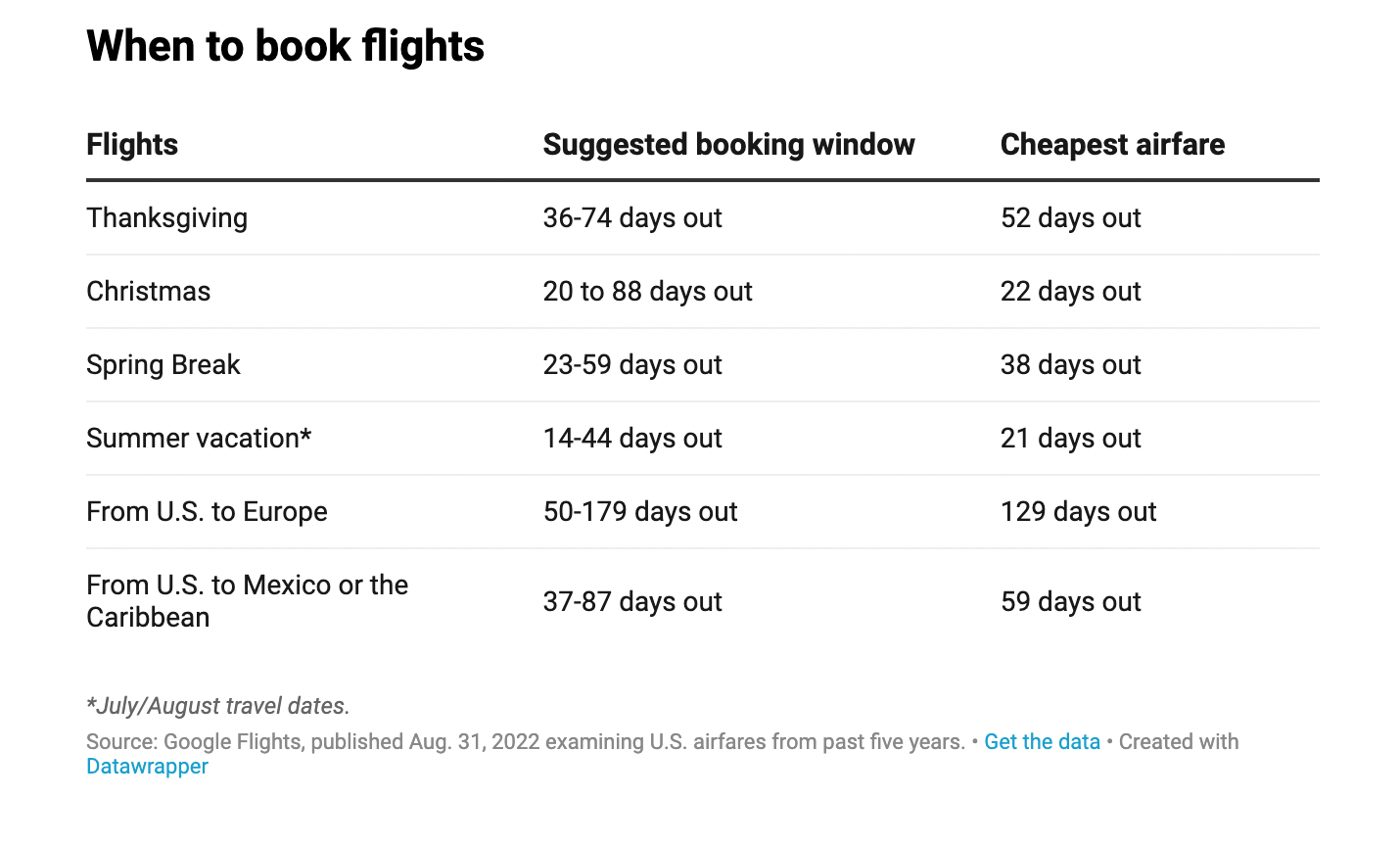
  • Booking far in advance: Common sense might suggest that surely the further in advance you book a flight, the cheaper it should be as prices rise for last-minute bookings. It somewhat makes sense, but it’s not accurate, and you might actually end up paying more ($50 on average) if you book too far ahead instead of during the prime booking window of 4 months to 3 weeks before.


  • Dynamic currency conversion: A dynamic currency conversion is an option offered by most credit cards that allows you to pay in the country’s local currency rather than your origin country’s. Sounds intuitive, but it often comes with a fee of up to 8% and maybe a bad exchange rate too. 

Take this related lesson on this topic and earn Dibs 🟡 while you're at it:

🔥 TODAY'S MOVERS & SHAKERS

  • Gamestop (+7.1%) despite declining sales and quarterly earnings loss; the gaming retailer also announced a partnership with crypto exchange FTX.
  • Asana (+28.7%) as the communication software company reported quarterly earnings that were better than expected. 
  • Sabre (-9.1%) shares are down as the travel tech company was downgraded by analyst Mizuho with a price target of $7 vs. $8.
  • Bitcoin (+0.05%) to $19,302.40 (1D)
  • Ethereum (+0.8%) to $1,641.87 (1D)

This commentary is as of 8:30 am PDT.

🌊 BY THE WAY

  • 🌎 Answer: 2040. Every new passenger car sold in the world will be electric by 2040, says Exxon Mobil CEO Darren Woods (CNBC)
  • ⛈️ Is climate action a good investment criterion? (ETF.com)
  • 📱 Apple’s biggest iPhone launch surprise: No U.S. price hikes despite inflation & supply chain issues (CNBC)
  • 📐 ICYMI. How the CPI measures the cost of living (Finny)
  • 📈 Finny lesson of the day. For those of you with high household income and lots of realized capital gains (ahem... incentive stock options or ISOs), learn more about the Alternative Minimum Tax or AMT: 

Finny is a financial education platform on a mission to make your money work for you. We offer a customized financial learning platform through bite-size, jargon-free lessons, money trends & insights.

The Gist is Finny's twice-a-week (Tues & Thurs) newsletter covering personal finance & investing insights and money trends. Finny does not offer investment and stock advice or endorsements. The Gist content team: Chihee KimAustin Payne, Carla Olson. 

We're thankful for the support of today's sponsor & partner⁠—Private Wealth Academy—as they make rewards on our platform possible. If you're interested in sponsoring The Gist, please reach out to us. And if you have any feedback for us, please contact us.

© Finny 2022. All rights reserved.
736 Paloma Ave, Burlingame CA 94010