
⚡Big Tech’s Carbon Retreat Could Become Climate’s Next AI CasualtyPlus: Huawei, DeepSeek, and the Big Threat.
As tech companies struggle to keep up with rising energy demand, they’re doing whatever it takes to protect margins, meet investor expectations, and maintain a competitive edge. That now includes scaling back carbon emission goals and purchasing fewer carbon credits, raising a bigger question: where does this lead long term? At the same time, Huawei is emerging as a serious challenger to Nvidia and broader U.S. chipmakers, signaling intensifying global competition in AI infrastructure. Let’s dive in and stay curious.
📰 AI News and Trends
Other Tech News
Big Tech’s Carbon Retreat Could Become Climate’s Next AI Casualty
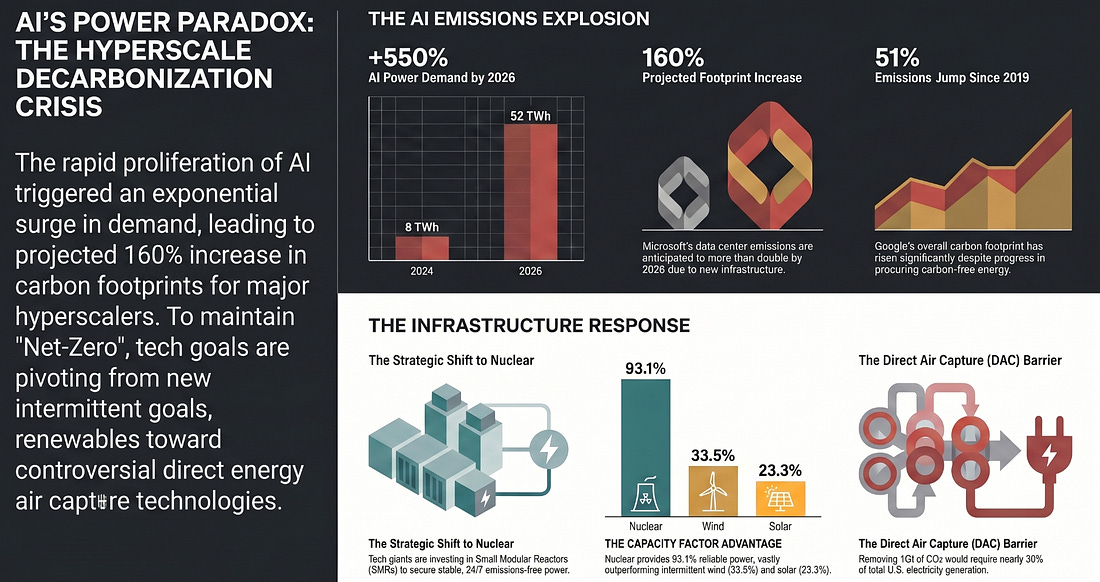
Microsoft’s reported pullback from future carbon removal purchases is the clearest sign yet that the AI boom is colliding with Big Tech’s climate promises. According to Heatmap, Microsoft has told some suppliers and partners it would pause future purchases, although the company says its carbon removal program has not ended and that it may simply adjust pace and volume as it refines its strategy. Even that softer wording matters. Microsoft has been the backbone of the young carbon removal market, accounting for roughly 87% of purchases in 2025 and 56% in the first quarter of 2026, while Heatmap reported it made about 90% of global purchases last year. The pressure is coming from electricity. As companies race to build AI data centers, their power demand is surging faster than clean energy supply can keep up. The Associated Press reported that Google’s emissions have risen nearly 50%, Amazon’s 33%, Microsoft’s more than 23%, and Meta’s more than 60% as the sector struggles to reconcile years-old climate pledges with the immediate need for more computing power. In that sense, Microsoft is not alone. It is the most visible company stepping back from carbon removal buying, but Google, Amazon, and Meta are also showing how AI expansion is weakening climate commitments in practice, even if they have not formally abandoned them. This is a big issue for two reasons. First, carbon removal was never supposed to replace emissions cuts, but climate scientists say it is still necessary to reach global temperature goals. If the largest corporate buyer slows down, a fragile industry loses the demand signal it needs to scale. Second, if tech companies decide that power growth matters more than climate follow-through, they risk locking in more gas-fired electricity, higher emissions, and a market message that sustainability promises can be postponed when AI profits are at stake. That would hurt not only carbon removal startups, but also the credibility of corporate climate pledges across the economy. 🧰 AI Tools of The DayAutonomous Agents
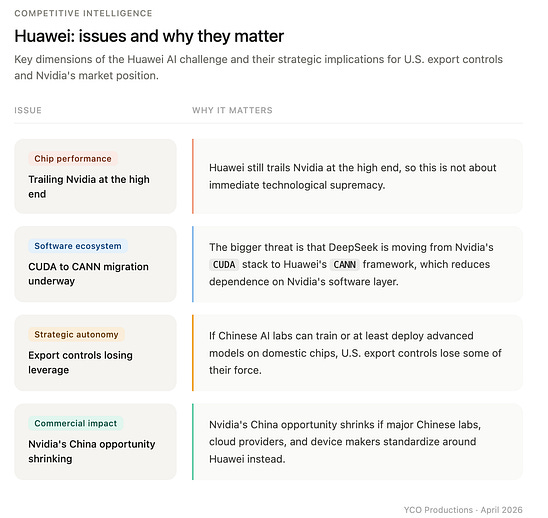
Huawei, DeepSeek, and the Big Threat.In a recent interview, Jensen Huang pointed out that Huawei is becoming a threat to Nvidia and to the US tech landscape entirely. Huawei has not made a better chip than Nvidia. And it may not be near that. The more important point here is that Huawei may be becoming good enough, especially when paired with a leading Chinese AI company such as DeepSeek. That is what makes Jensen Huang’s warning significant. If DeepSeek can run a major model on Huawei’s Ascend platform, then China no longer needs to match Nvidia chip-for-chip to weaken Nvidia’s position or reduce America’s leverage over the AI stack.
What makes this a potential blow to Nvidia is that Nvidia’s moat has never been just about having the fastest silicon. Its real strength has been the combination of chips, software, developer tools, and industry lock-in. Researchers build for CUDA because CUDA is the default. Startups buy Nvidia because its software was written for Nvidia. Cloud providers stock Nvidia because customers expect Nvidia compatibility. Once a serious Chinese lab proves that frontier-class models can be adapted to Huawei’s stack, that lock-in begins to weaken. That matters beyond DeepSeek itself. DeepSeek is important because it can act as a proof of concept for the rest of China’s AI sector. If one of the country’s most visible AI firms shows that Huawei hardware is commercially usable, then other Chinese companies may decide that the cost of switching away from Nvidia is worth paying. Even if Huawei chips remain less powerful, they can still become strategically decisive if they are sufficiently available, sufficiently optimized, and supported by a growing domestic software ecosystem. In technology markets, good enough plus local control can be more disruptive than a technically superior but politically constrained foreign supplier.
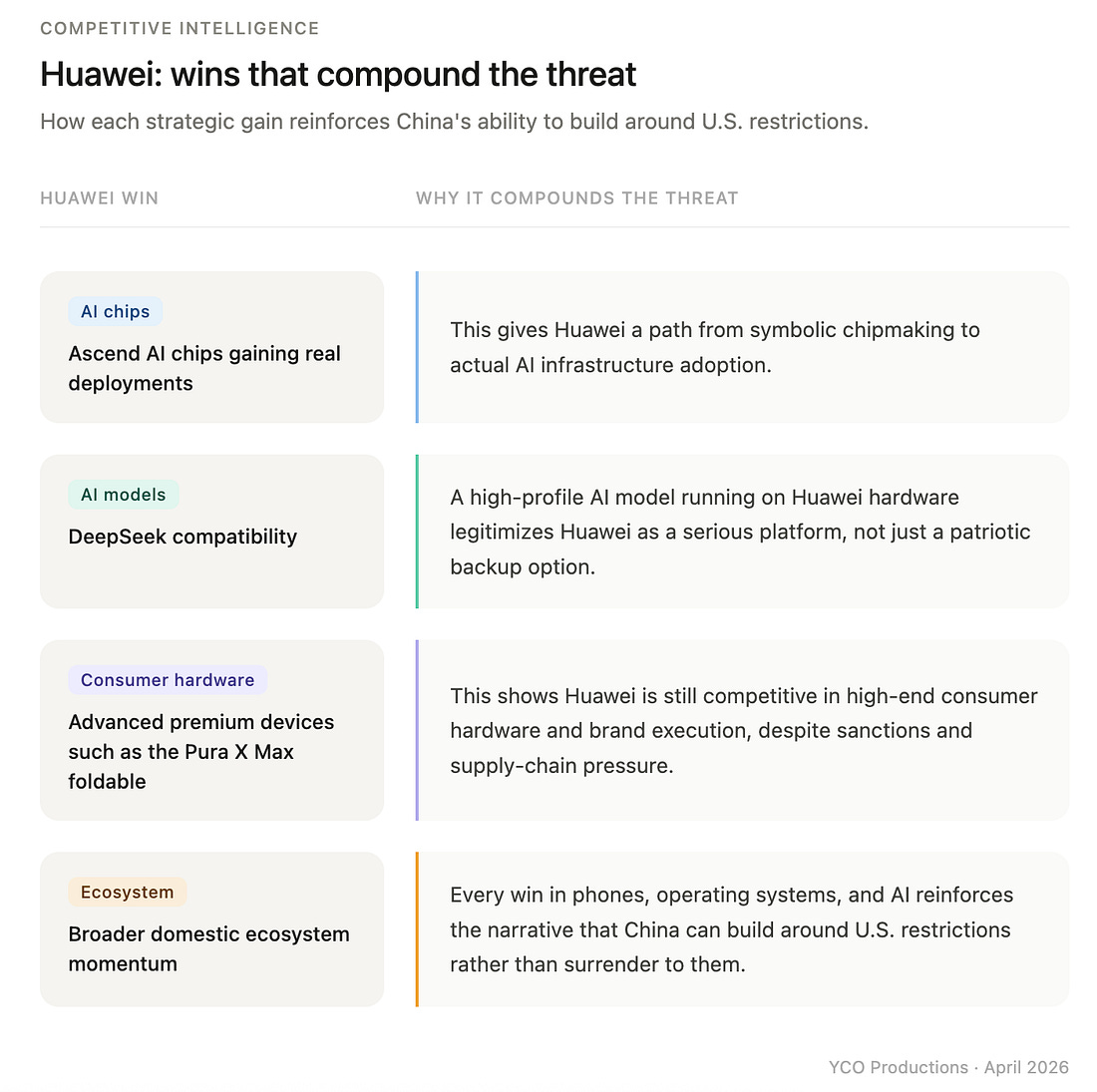
The foldable-phone example matters for the same reason. Huawei’s launch of a widely available premium foldable ahead of Apple and Samsung is not directly an Nvidia story, but it strengthens the broader Huawei narrative: this is a company that sanctions failed to kill. Instead of being frozen out of the market, Huawei has re-emerged as a company capable of setting the pace in selected categories. That matters because perception influences procurement, partnerships, and state backing. A company that looks like a survivor in smartphones is more likely to be trusted as a long-term platform in AI infrastructure as well. For U.S. companies more broadly, the danger is not only lost sales. The danger is the emergence of a parallel technology system. If Huawei supplies chips, operating systems, cloud infrastructure, and flagship devices, then Chinese firms may no longer need American suppliers in the most strategically important layers of the stack. NVIDIA loses accelerator demand. U.S. cloud companies lose influence. American software ecosystems lose default status. And Washington loses part of the coercive power that came from controlling the tools on which advanced AI depended. This is why Huang’s comment is so striking. He is effectively saying that the real risk is not that Huawei becomes better than Nvidia next quarter. The risk is that Huawei and DeepSeek together prove that China can build an AI path that is independent enough to be viable. Once that happens, export controls stop being a choke point and start becoming an incentive for China to accelerate replacement. In that scenario, Huawei’s recent wins are not isolated product victories. They are signs that an alternative AI and consumer-tech ecosystem is becoming more real. 📚Learning Corner🚀 Showcase Your Innovation in the Premier Tech and AI Newsletter (link) As a vanguard in the realm of technology and artificial intelligence, we pride ourselves in delivering cutting-edge insights, AI tools, and in-depth coverage of emerging technologies to over 55,000+ tech CEOs, managers, programmers, entrepreneurs, and enthusiasts. Our readers represent the brightest minds from industry giants such as Tesla, OpenAI, Samsung, IBM, NVIDIA, and countless others. Explore sponsorship possibilities and elevate your brand's presence in the world of tech and AI. Learn more about partnering with us. You’re a free subscriber to Yaro’s Newsletter. For the full experience, become a paying subscriber. Disclaimer: We do not give financial advice. Everything we share is the result of our research and our opinions. Please do your own research and make conscious decisions.
|






No comments:
Post a Comment