
🎓 The Third Revolution - Education After AIPlus: China just overtook the U.S. as the top address for elite AI talent
Education is changing fast, and it should be, the world isn’t remotely the same as it was 100 years ago, but the classroom mostly is. Companies and individuals are stepping into that gap with alternatives. Some are genuinely trying to fix it. Others are building “education” that quietly optimizes for their own pipeline, training the next generation of workers for them, or grooming the next founder to grow their portfolio. A new wave of investors is throwing money at schools and campuses for the same reason they fund startups: hoping to get in early on the next great researcher or entrepreneur before anyone else does. Whatever the motive, the shift is real. YouTube was built so anyone could post a video for anyone to watch, and it’s quietly become a university on steroids, where you can learn almost anything for free, on demand, from whoever’s actually good at it. Anyone ready to learn now can learn. The catch: the skill that matters most isn’t absorbing information anymore, it’s learning how to learn, and knowing exactly what’s worth learning in the first place. Information overload and algorithms built to hold your attention make it harder than ever to see past the noise and find what you, or your kids, actually need. But doing that work is worth more now than at any point before. Today we share how and why education is being rebuilt from the ground up, how AI-driven algorithms are quietly built to find and exploit the weakest users instead of protecting them, and how China just overtook the U.S. in the race for top AI talent. Let’s dive in. In today’s issue:
📰 AI News and Trends
The Third Revolution - Education After AI
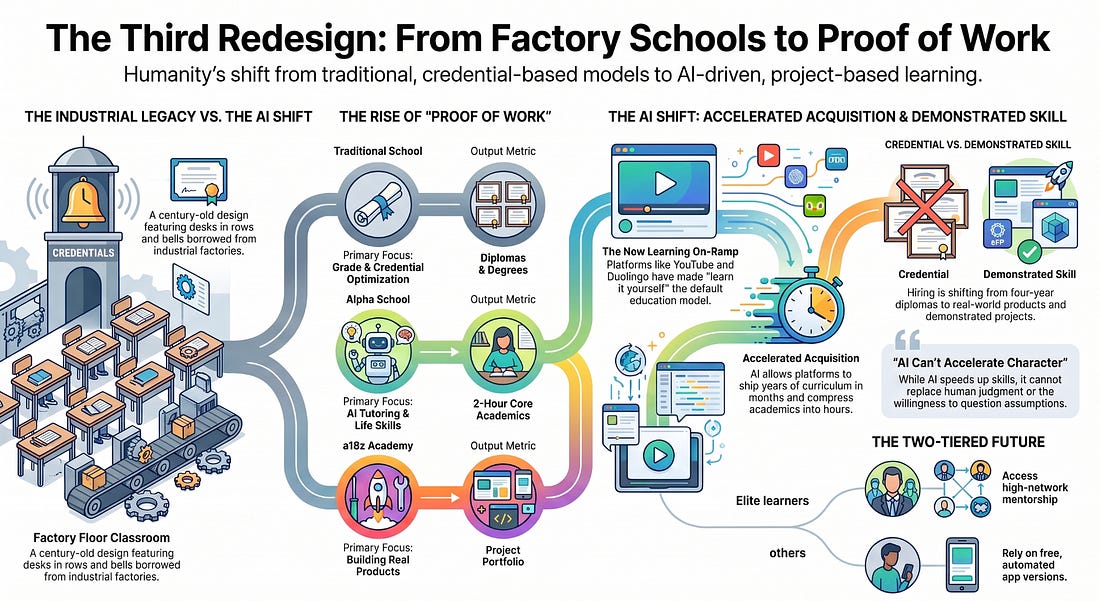
Every hundred years, we redesign how humans learn, because we redesign what humans need to do. Agriculture taught us land management. Industry built the modern school which left us with desks in rows, bells between periods, a design borrowed straight from the factory floor. That system hasn’t changed much in a century. We’re now at the start of a third redesign and this time it’s questioning whether the classroom itself survives. The proof-of-concept has been live. Youtube is basically a place where you can learn anything and everything, if you really want to learn. Duolingo has brought a new language to millions and is expanding into other subjects. Udemy, Maven, and many other platforms have been helping us learn on the go. Andreessen Horowitz just announced a full college alternative, the Horowitz Andreessen Academy. Fifty students, one year, tuition-free, no tests, just real products built from day one, taught by working entrepreneurs (AI CEOs and researchers among them), backed by $42M from Anthropic, Google, Meta, OpenAI, Nvidia, and Palantir. “The training that worked for the Industrial Revolution isn’t going to map onto the AI revolution” shared Co-founder Ben Horowitz It’s not alone. Alpha School compresses core academics into two AI-tutored hours a day, Geoffrey Hinton has publicly praised the model, with the rest spent on projects and life skills, for about $40K/year. Duolingo used to take years per language course; AI now lets it ship 148 new courses in one year, and it’s expanded into math and music. Add Maven, Udemy, and YouTube-as-university, and “go learn it yourself from whoever’s best” is now the default on-ramp for a whole generation. The real debate is, What school is for? On a recent podcast, Replit’s Amjad Masad and a16z Academy’s Gagan Biyani argued the most valuable trait young people bring is willingness to question assumptions, something grade-and-credential optimization trains out of people. Masad even calls early startup-founding a form of “premature optimization”: kids professionalizing before they’ve built the judgment to know what’s worth building. AI can accelerate skill acquisition. It can’t accelerate character. The earliest, best-resourced versions of this shift go to kids already near the money and the network, which are a16z’s 50 San Francisco slots, $40K private tuition. Everyone else gets the free app version, which helps, but isn’t the same bet. The most exposed are the credential-dependent middle, if hiring shifts toward demonstrated projects over diplomas, the economics of the traditional four-year degree get shaky fast, especially for families who took on debt believing the old deal still held. The main point here is that AI isn’t replacing teachers so much as replacing the credential with proof of work. The question every one of these experiments is really asking is that once learning gets radically faster and cheaper, what’s actually worth teaching, and who learns it first? That second half is the part the funding announcements never lead with. DraftKings built an AI to find its best “investment” — a problem gamblerDraftKings spent since 2023 building a machine-learning model that scores users by play frequency, balance, and loss-to-wager ratio, an internal “elasticity” score predicting who’ll lose the most after a free bet. Per a 40-source NYT investigation, one ex-analyst put it plainly: “the best investment would be a problem gambler.” A parallel model to flag at-risk users for help was fully built, then shelved in 2025, hours before it was set to be presented to the company’s own responsible-gaming chief. DraftKings disputes the framing. DraftKings isn’t the outlier, it’s the industry default. Turns out “score your most exploitable customer” is a well-worn AI playbook, not a gambling-specific sin:
The model isn’t the ethics problem. The business incentive is. Any company sitting on rich behavioral data has both versions sitting right there, which one gets funded is a leadership decision, not a technical one. China just overtook the U.S. as the top address for elite AI talent
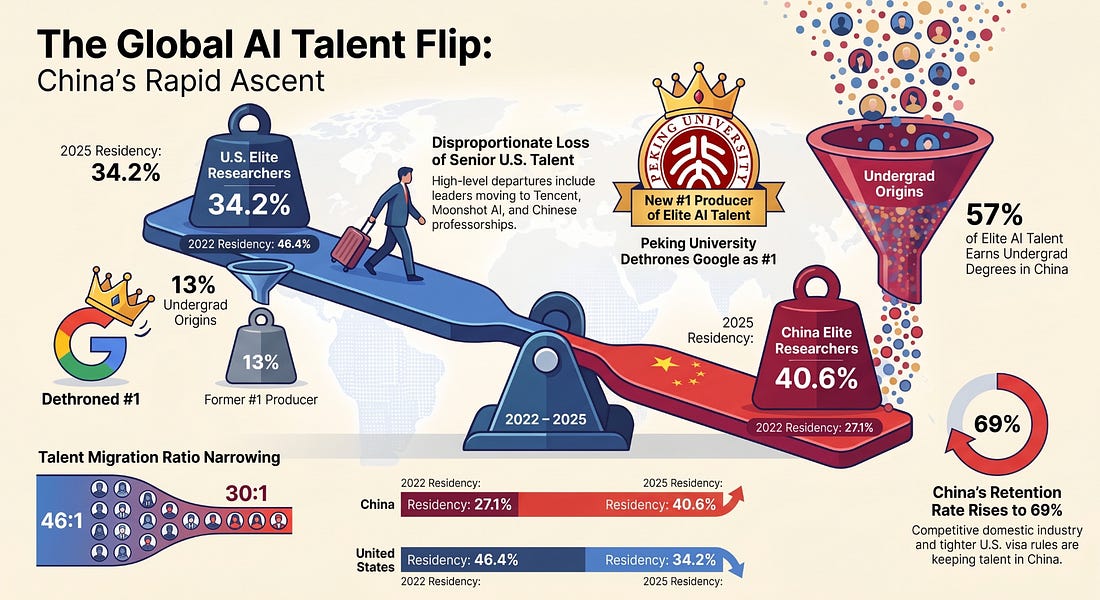
New Carnegie China data tracked 25,677 researchers from NeurIPS 2025, the field’s top conference, and found China now hosts 40.6% of elite AI researchers vs. the U.S.’s 34.2%. In 2022, it was the reverse: 46.4% U.S. to 27.1% China. Full flip in three years. In terms of where researchers earned their undergrad degree, China accounts for 57% of the world’s elite AI talent, the U.S. just 13%. China is clearly out-producing everyone. The U.S. is still winning the import game, but the margin is shrinking fast America remains a net importer of AI talent (+2,145 researchers in 2025 vs. China’s -1,729), and the flow is still lopsided: 30 Chinese-origin researchers work in the U.S. for every 1 U.S.-origin researcher in China. But that ratio was 46:1 in 2022 — narrowing hard. China’s AI industry got genuinely competitive, and U.S. visa rules tightened for Chinese STEM grads. Which resulted in China’s talent retention jumping from 57% to 69% in three years (still trails the U.S.’s 89%, for now). Carnegie tracked 100 elite Chinese-origin researchers in the U.S. as of 2019. 87 stayed, but the 10 who left were disproportionately senior: two startup founders, two tech execs, five professors. To prove the point: Yao Shunyu left OpenAI for Tencent and was named chief AI scientist within three months. Yang Zhilin left a CMU PhD track to found Moonshot AI. Princeton separately counted ~50 tenure-track Chinese-origin scholars leaving U.S. universities in just the first half of 2025. South Korea (KAIST now #3 globally) and Singapore (NUS/NTU both cracked the top 20) are quietly climbing. Peking University dethroned Google as the #1 talent-producing institution, but surprisingly Europe and India are both fading. 🚀 Showcase Your Innovation in the Premier Tech and AI Newsletter (link) As a vanguard in the realm of technology and artificial intelligence, we pride ourselves in delivering cutting-edge insights, AI tools, and in-depth coverage of emerging technologies to over 55,000+ tech CEOs, managers, programmers, entrepreneurs, and enthusiasts. Our readers represent the brightest minds from industry giants such as Tesla, OpenAI, Samsung, IBM, NVIDIA, and countless others. Explore sponsorship possibilities and elevate your brand's presence in the world of tech and AI. Learn more about partnering with us. You’re a free subscriber to Yaro’s Newsletter. For the full experience, become a paying subscriber. Disclaimer: We do not give financial advice. Everything we share is the result of our research and our opinions. Please do your own research and make conscious decisions.
|





No comments:
Post a Comment