Thursday, April 15, 2021

😕 Buffett Indicator out of whack

April 15, 2021 View online | Sign up
TOGETHER WITH Finny

The word Thursday is actually derived from the old English word Thor, which refers to the Germanic god of thunder. That guy definitely shorted Tesla last year. 

Here's what we cover today:

  • The Buffett Indicator is out of whack, and what that means
  • Is it worth it to move somewhere more affordable? The stats and our take
  • Reboot your budget through your receipts. You read that right
  • How much savings is enough for my age? A way to think about it

And can you guess what Google search spiked 2,450% in the past month? Find the answer in the Trending section below.

INVESTING

The Buffett Indicator is out of whack

The Buffett Indicator is not an app that shows you all the nearest Golden Corrals in your local area (sorry, Texas). It's actually an investing tool named after Warren Buffett, and while it makes sense that an investor with the resume of Buffett would have an indicator of his own, many people haven't heard of it before.

So, what the heck is the Buffett Indicator?

The Buffett Indicator is a market data point that attempts to determine whether or not the aggregate market is valued properly. It's actually called the market cap to GDP ratio, and has been attributed to Buffett due to his comment suggesting that it's "probably the best single measure of where valuations stand at any given moment."

As its origins suggest, the indicator is calculated by totaling up the market cap of all publicly traded companies in a given country, and dividing it by the nation's gross domestic product. As you can probably surmise, the higher the aggregate market cap relative to GDP, the more overvalued a market potentially is, whereas the opposite rings true of an inverse scenario.

Okay, cool, but what makes it out of whack?

After last year's flash crash, and even before then if you include the almost linear ten-year climb of the ratio, the Buffett Indicator has been seeing a lot of red. Essentially, according to this metric, the market as a whole is overvalued in a historic way. It's recently gone so high Elon Musk is asking Cathie Woods for her opinion on it.

The indicator currently sits at about 200%, give or take considering fluctuations—an all-time high. How do we get this number?

We took the present market cap of all public companies and divided it by the country's annualized (estimated) GDP based on 2021's first-quarter production: $49.3T total market cap & GDP estimate of $21.8T. 49.3/21.8 = 2.26, or 226%, as of March 31st 2021. 

For some perspective on this, during the internet bubble the indicator topped out at about 67%, and during the bottom of the financial crisis, it was at about -48%. It's been climbing, despite obvious fluctuations, ever since then.

This is what leads us to our assessment of "out of whack." The market has been supposedly overvalued for so long, that it begs the question of whether the indicator is valid now. As with anything, the average shifts over time. Experts used to consider the average of 75% to be a good balance, but that's shifted closer to a sentiment that 100% is a more relevant benchmark now, despite previously being considered a sign of an overvalued market.

The takeaway and things to consider

  • More companies going public results in a higher cap # 
  • We're in the midst of a potentially over-extended recovery

No one knows when the next market crash is coming, and the Buffett Indicator is no exception. Historically it's been a rare occurrence, with cyclic corrections and sector rotations being far more common. Interpret this reading accordingly—it shouldn't stop you from investing.

💡 If you're looking for companies that Warren Buffett would invest in today, because of their strong economic moats and competitive advantages, take a look at Finnyvest's Buffett stock screener.

HOUSING

Is it worth it to move somewhere more affordable?

Changing locations is becoming more and more commonplace in America. People are no longer staying local and working a union job until they get a nice pension and retire. The dynamics of employment are changing, and so are our living situations.

Based on the reports we heard in 2020, you might've thought a biblical level exodus was taking place in California as reports of residents vacating the state for cheaper locations continued to spread. California actually netted about a 135,000 resident loss in 2020. So, maybe not quite as dramatic as the bunch Moses supposedly led out of Egypt. 

Is it really worth it though? Moving is a hassle, costs money, and let's not forget often means a career change. Is moving your life to a cheaper location really worth the difference?

Comparing the cost of living in different locations

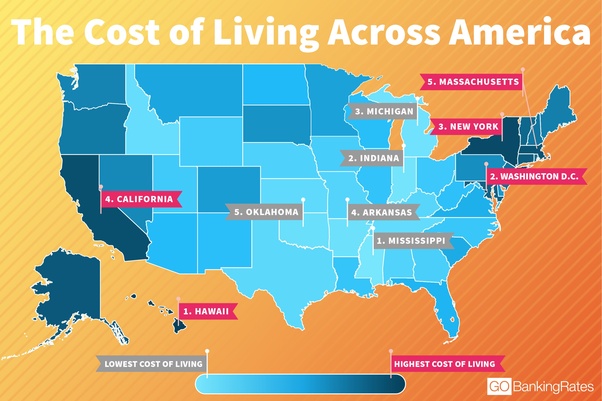
The cost of living index sets a base city rating of 100.  Below this would be considered cheaper than average, and above it, the opposite. Mississippi has the lowest COLI number of 2021, coming in at 86.1. Arkansas follows with an 86.9, Oklahoma at 87, and then 9 other states that sit below 90 such as Georgia, New Mexico, Wyoming—pretty much the places you'd expect.

The national average in 2021 is 104.63, but let's consider the fact that we have two extreme outliers in California and Hawaii. California has a rating of 151.7, and Hawaii is at 192.9. In other words, there are a lot of places to choose from that are within the reasonable range.

Home prices

The median home valuation in Georgia is bout $176,000. In Illinois, it's $194,000. Arizona is $225,000, Texas is $172,000, Montana $230,000, and Vermont $227,000. Noticing a pattern? They're all within about the same $100,000 range. 

Out of all 50 states, 26 have a median average home price below $200,000. 15 fall between 200K and 300K, and only 9 above that. Of that 9, only 2 medians sit above $300K: California and Hawaii. They're also extreme statistical outliers, sitting at $505K and 615K each.  

So, what does all this mean? That there's a lot of places to live for a reasonable price, and moving just because of the cost of living is only applicable to a few groups.

Questions to ask yourself

If you're considering moving, it's important to objectively analyze your situation. 

How will moving help me meet my short or long-term goals? How much am I paying to live where I do, and what am I getting in exchange for that? Could I obtain something comparable or even better somewhere else for a lesser cost? How will this impact my career, my family, or life as a whole? 

Our Take. There are plenty of good reasons to move that go well beyond financials. But it's important to be honest about those reasons because most people won't find themselves in a situation where they're paying an exponential cost of living comparable to the rest of the country.

PRESENTED BY FETCH REWARDS

Reboot your budget with your receipts

Let's talk about receipts. You know, those slips of paper that usually end up crumpled in your pocket or purse, stuffed into your junk drawer, or worse—immediately tossed into the garbage. 

If you have the Fetch Rewards app, you'll start seeing your receipts differently. Earn rewards for simply snapping pictures of your receipts.

Here's how it works:

  • Download the app and take a photo of ANY receipt to start earning points. Every receipt counts, even those from online retailers (like Amazon!).
  • Redeem points for free gift cards. There are hundreds of options, including Visa, Amazon, Target, Starbucks, Ulta, and more!

Reboot your budget and money-saving goals with Fetch Rewards. It's easily one of our favorite free apps of 2021!

Download the app and use code "FINNY" during signup and earn 3,000 bonus points for your first scanned receipt.

BUDGETING & SAVING

How much savings should I have for my age?

They say comparison is the thief of joy, but if that's the case then it must also be the giver in some cases. Comparing yourself to others your age in terms of how good you are at saving money can either serve as validation or a motivator, but both are positives to financially woke people like yourself.

Fidelity recommends savers to stash away 3x their annual salary by the age of 40

So at a $50,000 salary, that's $150,000 saved. A saver who starts at age 22 with that $50,000 salary would need to save a little over $8,000 per year in order to achieve this by 40. That comes out to a bit over 16% of your annual gross income. 

They also recommend that...

  • by 50, you should have 6 times your salary saved.
  • by 60, you should have 8 times your salary saved.
  • by 67, you should have 10 times your salary saved.

How should you prioritize your savings?

There are two types of saving that hold priority over everything else: retirement and emergency funds. They serve two different purposes, one is an insurance policy while the other is a full income replacement strategy, and everyone's life has different needs.

Here are some general rules to apply that can help preserve your future:

  • Establish an emergency fund of 3-6 months of expenses first, as a safety net.
  • Put away 10-15% of your gross income at minimum for retirement planning, and more if you wish. The later you wait, the higher you'll need to adjust to meet your retirement goals. 
  • Contribute to your company's 401k, especially if they offer an employer match. It may seem like a small percentage, but that free money compounds over decades. 
  • Based on your income, consider also opening an IRA or Roth IRA. Go for an IRA if you plan to withdraw the funds at a later date when your tax bracket is lower, and consider a Roth if you predict your tax burden will be higher in the future than it is now.

🚀 Learn or refresh yourself on how to boost your retirement savings:

✨ TRENDING ON FINNY AND BEYOND

  • 'When is the housing market going to crash?' is the red-hot search on Google that spiked 2450% last month—here's why (CNBC)
  • Coinbase's public listing is a cryptocurrency coming-out party (New York Times)*
  • ✋ Have a personal finance question you want us to ask us or want us to cover in a future edition? Let us know!
  • Finny discussion post of the day. What would you tell your younger self about investing for retirement?

How did you like Finny's The Gist today? (Click to vote)

Refer friends to Finny

Alternatively, copy and paste this link and send to your friends:
https://askfinny.com/i/5e4fef3a85965903d5b88248

Finny is a personal finance education start-up offering free, game-based personalized financial education, a supportive discussion forum, and simple stock and fund tools (aka Finnyvest).  Our mission is to make learning about all things money fun and easy! 

The Gist is Finny's newsletter to our community members who are looking to make and save more money, protect their finances and be their own boss!  It's sent twice a week (Tues/Thurs). The editorial team: Austin Payne and Chihee Kim.

*Sponsors or advertisers offer unique consumer services.  We're thankful for their sponsorship to enable Finny to offer free financial education. Here's our advertiser disclosure. 

If you have any feedback for us or interested in sponsoring, please send us an email to feedback@askfinny.com.

Copyright © Finny 2021. All rights reserved.
736 Paloma Ave, Burlingame CA 94010

Tuesday, April 13, 2021

🍦 Value investing in flavor

April 13, 2021 View online | Sign up

Hey smart people, get out your reading glasses. The Tuesday ones specifically. Here's what's on the menu for today: 

  • The resurgence of value investing, and how to find undervalued plays
  • Prince's estate drama, and the takeaways
  • What's your life worth? Way more than what the life insurance policy says
  • It's financial literacy month. Join Tiller Money & Finny for a Financial Literacy Q&A on April 22

INVESTING

The resurgence of value investing

Image source: WSJ

We all want to find the next $MARA, the next Zoom, or the next parabolic runner that's moving solely on the basis of Reddit hype and diamond hands that dumps the next day. Looking at you, $NAKD. That's all well and good, but even the best investors know this to be a gambler's game most of the time.

A good alternative to the high risk, high reward venture of growth investing is value plays, and it seems to finally be getting some shine again after a long stay in the dark. Value investing has been vying for a comeback lately after growth stocks have essentially dominated it for the last decade.

Perhaps one of the most famous value investors of all time is Benjamin Graham. Graham even wrote two books covering his strategies, oh and he also taught Warren Buffet for a while too.

So then why has this promising method seemingly fallen to the wayside?

Value investing is the less attractive, but oftentimes more reliable alternative to the flashy prospects of growth stocks most new investors are drawn to. It often involves buying stocks that no one is thinking about anymore, or that just seem downright boring at the time of purchase. 

It's like a really good sale. You know how we fall prostrate to worship the retail gods every time Black Friday comes around just because H&M is having a 50% off sale? Well, the stock market does similar things, but way more than once a year.

Value investors seek to find undervalued plays that have mostly been beaten down due to the emotional nature of the stock markets. Market indexes have a way of dragging down entire sectors and exaggerating both gains and losses of stocks just because of public sentiment. The market is a social creature, but value investing seeks to prey on that. 

Value plays are typically more well-established companies that have already matured beyond their growth period. They've already been through puberty, and a mid-life crisis of sorts has gotten them a bit down lately.

Finding undervalued plays is the name of the game here, and there are many ways to go about doing that. Investors will use a myriad of different metrics and even more qualitative indicators to try and sniff out a diamond in the rough. The goal here is to find the (albeit subjective) intrinsic value of a stock, which is calculated based on a number of things, like:

  • P/E Ratio. Price to earnings ratio calculates the price of the stock relative to a company's reported earnings. The average P/E ratio for the S&P 500 has historically been about 12-13, which means the price is trading at 12-13x earnings per share. A higher ratio is either indicative of an overvalued stock, or that investors are in anticipation of growth in the future. Value investors though, look for stocks with an undervalued P/E ratio. 
  • Free cash flow is king and another valuable data point to use. It's measured how much extra cash a company has after subtracting operating expenses, capital expenditures, and other relevant sources of capital drain. A business with a higher free cash flow is likely to have more money to invest in growth, pay off debt, and expand, making it a solid candidate for being undervalued.
  • Debt to equity ratios, or D/E, are used to determine what the company's debt looks like in proportion to its assets. A lower debt to equity ratio shows that the business is using less debt to finance its assets, and is generally a good indicator of an undervalued stock depending on the price. This also varies from industry to industry, with some sectors having more fixed costs than others. 
  • Other relevant indicators to check as part of your due diligence: P/B Ratios, PEG Ratio, CROIC and more.

Our Take. We could go on for days about the endless opinions and strategies that can create a successful value investment strategy, but each investor should curate their own personalized method by juxtaposing their goals with their tolerance, and of course their own research.

📚 Take this bite-sized quiz to review fundamental analysis of stocks and the key metrics that can help you with your due diligence:

ESTATE PLANNING

Prince's estate drama and the takeaway

When a family loses a loved one, the last thing they want to endure is a convoluted estate dispersion and disagreements about the deceased's assets. This has been the case for the family of former world-famous artist, Prince, who's been dealing with an ongoing dispute over his estate for 5 years now. 

Prince did not have a will to establish who would receive his assets and how it would all be dispersed, and that's helped to create one of the most complicated probate negotiations between private parties and the IRS. And it certainly hasn't helped that his estate is so massive. The family's private estimation comes in at $82.3 million compared to the IRS's at $163.2. 

Why does all this matter, and what can we learn from it? You might not have an estate with a fluctuating value in the hundreds of Ms, but an estate of any size can quickly become unnecessarily messy if there aren't clear guidelines on how to execute it after death. Unfortunately, we've seen this play out over and over again (ahem... do the names Tony Hseih, Arethra Franklin, Sonny Bono, and Jimi Hendrix ring a bell?).

Here's what we took away from all this.

  • Most wills are simple, and this can easily be avoided. It's unlikely you'll find yourself in a situation like Prince's family, and creating a will is something that can even be done in a matter of minutes online for most people.
  • The will is just a means to an end. The overarching point here points to financial intentionality, and there are other financial steps that can be taken prior to your departure that contribute to the preparedness of your family, and may even decrease your tax burdens as you age. Case in point: you can gift over $11 million over the course of your life without ever having to pay gift tax on it via what's called the lifetime gift tax exemption.
  • The time to act on your future is now. We're not pessimists, but you never know what life holds. Children and grandchildren or not, no one wants their partner to deal with the aftermath of a heartbreaking situation on top of becoming the default executioner of your estate. This is something no one likes discussing, but something that can bring peace of mind for the rest of your life. 

💡Tooltip. If you need affordable user-friendly options to create a will or think you may need an estate plan or more, check out Trust & Will, Fabric, and Rocket Lawyer.

MONEY THOUGHTS

What's your life worth? Way more than what the life insurance policy says

The philosophical question of  "what is life worth?" has been explored by nihilists and fundamentalist religions alike for thousands of years, and believe it or not, they still haven't figured it out. But someone else did though, and it wasn't Nietzsche, Camus, or even Jesus himself, it was actually...the government.

The history of determining life's value

In 1972, a member of Nixon's administration set out to determine the economic value of human life for the sake of figuring out how this has influenced regulatory decisions over the years, and the number they came up with? $885,000 in today's value. 

This was later adjusted to $1 million, and today this figure ranges from $8 to $10 million USD. The Consumer Product Safety Commission uses $8.7, the EPA goes by $7.4, and the DOT says $9.6 million dollars.

The reasons behind this are pretty impersonal, and kind of...scary

Calculating the value of human life is used by regulatory agencies and governments alike to calculate the cost-effectiveness of certain health and safety measures taken. These regulations, when they exceed a certain price point, are required to pass a cost-benefit test, which determines whether or not it gets implemented. For example, if the cost of installing seat belts that beep when you don't buckle up exceeds the value of lives saved by wearing it, then it gets rejected. 

Think about it though, we do this all the time. Life insurance, anyone? We typically value ourselves far less than $10 million dollars when we buy that $500,000 life insurance policy, so this is nothing new for most of us. There just seems to be a disconnect when government and regulatory bodies put a price on our life. 

CELBRATING FINANCIAL LITERACY MONTH

Join Tiller Money & Finny for a financial literacy Q&A

Join Heather Phillips of Tiller Money & Chihee Kim of Finny on Thursday, April 22nd at 12:30pm EDT for a zoom conversation about:

  • Financial literacy and what it means in today's era of digital spending & tracking and current economic landscape
  • Review of resources and technology that are helping bridge the financial literacy gaps 
  • And an opportunity to ask your own financial literacy questions!

What is Financial Literacy Month? Financial Literacy Month is a nationally recognized month-long campaign to bring awareness to the need for more financial education in schools and for adults.

What is Tiller Money? Tiller's mission is to create customizable tools that empower people with greater understanding, confidence, and control of their financial lives. They help people track all their accounts in one place, so they always know where their money goes, and confidently plan their financial future.

Join us on April 22nd by registering right here:

✨ TRENDING ON FINNY AND BEYOND

  • World stock markets—where is the opportunity to invest? (Finnyvest)
  • Is it safe to eat at restaurants again? Here's what to expect (WSJ)
  • Dwyane Wade made $196 million playing basketball, but still budgets (CNBC)
  • Looking for a financial coach who will guide you in sharpening your financial skills, all without making judgment or selling products? Meet Ilene Slatko of DSS Consulting and schedule a free consultation (DSS Consulting)
  • Finny lesson of the day. Since we're talking about value investing, let's also review growth investing:


How did you like Finny's The Gist today? (Click to vote)

Refer friends to Finny

Alternatively, copy and paste this link and send to your friends:
https://askfinny.com/i/5f8efcfb251278302017ffa3

Finny is a personal finance education start-up offering free, game-based personalized financial education, a supportive discussion forum, and simple stock and fund tools (aka Finnyvest).  Our mission is to make learning about all things money fun and easy! 

The Gist is Finny's newsletter to our community members who are looking to make and save more money, protect their finances and be their own boss!  It's sent twice a week (Tues/Thurs). The editorial team: Austin Payne and Chihee Kim.

*Sponsors or advertisers offer unique consumer services.  We're thankful for their sponsorship to enable Finny to offer free financial education. Here's our advertiser disclosure. 

If you have any feedback for us or interested in sponsoring, please send us an email to feedback@askfinny.com.

Copyright © Finny 2021. All rights reserved.
736 Paloma Ave, Burlingame CA 94010

Thursday, April 8, 2021

🚧 Infrastructure, hot or not?

Logo

Happy Thursday! Let's get right to the money topics for today.

  • Infrastructure, hot or not? Implications of the $2 trilly plan.

  • One more way to save if you haven't filed your taxes yet. H-S-A.

  • Will rising interest rates derail the hot housing market? Our perspective.

  • Create better money habits. 3 actionable tips.

To ensure you are getting The Gist in your inbox, please move it to your primary folder (Gmail), or add it to your VIP (Apple Mail) or favorites (Outlook)!

INVESTING

Infrastructure, hot or not?

When you think of a good time, an interesting debate, a real hot topic, infrastructure is what's on your mind, right? We thought it might be, so let's break it down a bit.

Joe's Bill, and the Bill for Joe's Bill

Last Wednesday President Joe Biden unveiled a portion of his proposed infrastructure plan to help revitalize and progress America's infrastructure going forward. The plan contains $2 trillion dollars of spending, and outlines budgets for numerous areas.

  • About $600 billion would go toward transportation, including roadways, railroads, and bridges, all with a focus on cleaner energy. $174 Billion of the transportation portion would be put towards the adoption of electric vehicles, including stations, bus fleets, and government vehicles.

  • The "quality of life at home" section allocates $650 billion to the constructing, revitalizing, and "retro-fitting" of more than 2 million affordable homes and commercial buildings. Some of it would go to modernizing schools, replacing outdated plumbing, cleaner drinking water, and a lot more.

  • Another $400 billion would be injected into the elderly/disabled caregivers area, and $300 billion toward research, development, and manufacturing.

And there you go, a quick two trilly racks just like that. Ain't nothin' to a government.

Where America stands now, globally speaking

The US consistently comes in around 13th globally as far as total aggregate infrastructure. This is hard for most of us to believe as we often have no affiliations with public transit while driving our own vehicles in the suburbs, but numbers don't usually lie.

Some of the most noteworthy categories we're suffering in are as follows: aviation, drinking water, energy, schools, transit, and... all the important things. We actually seem to be doing best in the areas of ports and rail.

So, what are the potential implications for us if this is all put into action?

Infrastructure projects are often the tortoise of all the government's pet projects. They're slow to start and slow to develop. If seen through, the investments into updating schools, clean water, and a new emphasis on ensuring public goods can be a difference-maker for a lot of people.

Biden pledged that his long-term economic agenda would not add further to the growing national debt, and that the increase in taxes on corporations from the current 21% to 28% over a 15 year period is enough to pay for eight years of spending on infrastructure.

Let's just hope there isn't a trickle-down impact on the broader population because of higher corporate taxes. And at least for now, Biden continues to echo the statement that taxes won't be raised on anyone making less than $400,000 per year.

Assuming follow-through to move on these infrastructure projects, they could create the potential for new jobs, fueling optimism in the economy and ultimately the markets.

Where should you then look for investment opportunities? See what Finny's investment community has to say about just that:

SPONSORED BY LIVELY

One more way to save if you haven't filed your taxes yet

There's still time to save on last year's taxes and save smartly on your healthcare costs.

How? By opening and funding a free health savings account or HSA with Lively.

HSAs are like a 401K for healthcare but better, tax-wise. When you open an HSA, you can save up to $7,200 tax-free on last year's taxes. Your HSA grows tax-free and withdrawals for qualified medical expenses are tax-free. It doesn't get better than this triple tax benefit.

If you and your family are on a high deductible health plan, you qualify. That means, your health plan has a minimum deductible of $1,400 for individuals and $2,800 for families.

Lively HSAs work alongside high deductible health plans to make healthcare more affordable.

Save up to 25% on your taxes by contributing to an HSA for the 2020 tax year.

Learn more

HOUSING

Will rising interest rates derail the hot housing market?

It's been "a great time to buy a home" for a while now. As you've likely heard dozens of times over the last decade, interest rates are extremely low, and it's unlikely to be sustainable. But, that doesn't necessarily imply that the end is nye.

Some perspective, and a bunch of numbers

The current average FRM (fixed-rate mortgage) for a 30-year loan will run you about 3.39%, which is very low historically speaking. Recently though, this represents an upward movement. Last year's average 30-year rate was 3.11%, dipping as low as 2.68% in December.

Interest rates have been dropping, broadly speaking, for the better part of 40 years since they reached a peak of over 18% in the early 1980s inflation war. Between the early 90s and 2000s, rates hung out around 8% and stayed around 6% until 2010, falling further due to the housing crisis.

2021 has brought swift recovery to the rates though, up a whole half of a percent to 3.08% in early March, and as we can see, even higher lately.

So, is this going to derail the housing market?

Thus far, the housing market doesn't seem to have been negatively affected by rates moving up a bit. Despite rising rates from a year-to-year perspective, looking at the bigger picture makes it impossible to ignore the fact that, historically, home-buyers are still getting a pretty good deal.

Prospective home-buyers seem to have been saving their money over the last year, as various surveys have indicated, and it makes sense that future homeowners would be amongst the more financially responsible portions of the population.

The US is also dealing with an apparent housing shortage, with Freddie Mac estimating a 2.5 million unit shortage, even before the pandemic hit. The construction industry will be busy in 2021, while also dealing with similar shortages that are facing supply chains in numerous sectors.

Our Take. All of this combines to create and sustain the seemingly perpetual bull market on homes. The housing market has gone to the moon and come back a few times. Dogecoin has nothing on a good, old-fashioned mortgage. Are we being too pessimistic in awaiting a crash? No, we're being proactive and prepared, despite being okay for now.

FINANCIAL WELLNESS

Tips to create better money habits

Being proactive always beats being reactive

Planning ahead may seem like an option only for geeks but it can end up aiding you on your path to or sustenance of financial freedom. Plenty of research has shown that budgeting is more about psychology than money, and those who've been successful at it can attest to this. Here are a few practical tips.

  • Set an annual reminder to check your credit reports. You get a free credit report every week if you wanted to.

  • Set up alerts to stay on top of your checking account balance. Or else beware of overdraft fees if your bank charges them.

  • If you can't make a bill payment because of a financial emergency, call your lenders or creditors before your due date to see what options may be available to you.

Always explore your options, especially with loans

Exploring your options might sound like the phrase your ex used when they tried to let you down easy, but trust us, it can be used for way more than that.

We know it's pretty sweet and simple to just go on Rocket Mortgage and get an interest rate quote faster than an Amazon Prime package, but hear us out. Get at least another two quotes. Having options is always a power move, and there's strength in numbers. With interest rates chomping at the bit to rise, now is a good time to make the lenders play limbo.

Be discretionary with your credit, and where you get credit advice

Just because you get your third credit card offer in the mail this month does not mean you should apply for the card. You may have heard that the lower your credit utilization rate, the better the score. It's true.

But, another big factor playing into your creditworthiness is your AAOC. My what? Average age of account. When you open a new credit line, that account has an age of 0. Adding one every now and then to a seasoned credit history is no biggie, but if you're new in the credit game and just trying to build your history, be careful.

✨ TRENDING ON FINNY AND BEYOND

  • Infrastructure ETFs with the highest net assets (Finnyvest)

  • It pays to learn about personal finance on Finny! If you've been learning on Finny, redeem your Dibs for rewards, gift cards, enter our $100 giveaway and more. (Finny's rewards shop)

  • Sidecar Health is on a mission to make health care affordable by reimagining health insurance. Save 40% or more. (Sidecar Health)*

  • Build home equity and pay off debt as fast as humanly possible with Earnup (3 months free)*

  • Finny lesson of the day. With the $2 trilly plan, there may be investment opportunities in sectors. Here's our bite-sized quiz on this topic:


How did you like Finny's The Gist today? (Click to vote)

Read the archive
Facebook iconInstagram iconTwitter iconWebsite iconEmail icon

Finny is a personal finance education start-up offering free, game-based personalized financial education, a supportive discussion forum, and simple stock and fund tools (aka Finnyvest). Our mission is to make learning about all things money fun and easy!

The Gist is Finny's newsletter to our community members who are looking to make and save more money, protect their finances and be their own boss! It's sent twice a week (Tues/Thurs). The editorial team: Austin Payne and Chihee Kim.

*Sponsors or advertisers offer unique consumer services. We're thankful for their sponsorship to enable Finny to offer free financial education. Here's our advertiser disclosure.

If you have any feedback for us or interested in sponsoring, please send us an email to feedback@askfinny.com.

Copyright (C) 2021 Finny. All rights reserved.

You are receiving this email because you opted in via our website, www.askfinny.com.

Finny
736 Paloma Ave
Burlingame, CA 94010-3729

Add us to your address book

Update Preferences | Unsubscribe