The next AI era is here, and it requires living in the real world. AI needs us to wear it, move with it, and even drive it. Why? Because the next breakthrough isn’t more text, it’s massive amounts of real-world video and sensor data. Tech giants are now in a high-stakes race for both profitability and dominance, competing to capture physical data at scale through wearables, vehicles, and cameras everywhere. In this edition, we also share Physical AI tools and learning resources to help you understand and build the next phase of AI. Stay curious.
📰 AI News and Trends
Other Tech News
Your Payment Processor Is Hiding Your Revenue Leaks
Most businesses think churn = cancellations. - That’s wrong. What your payment processor doesn’t clearly show you:
We built a real-time financial command center on top of Stripe and any payment processor that shows:
The Next Era is Physical AI.
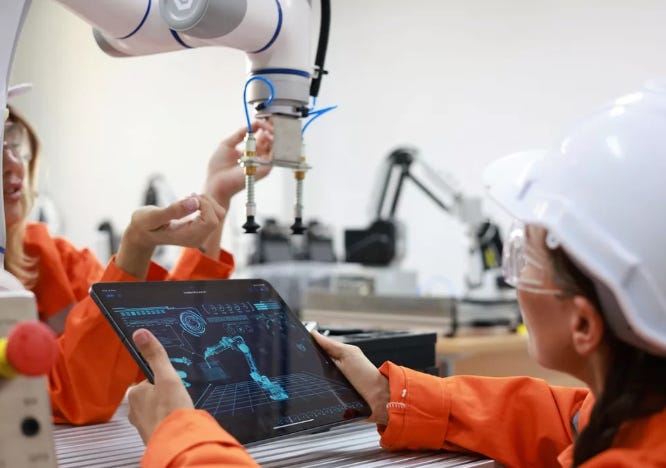
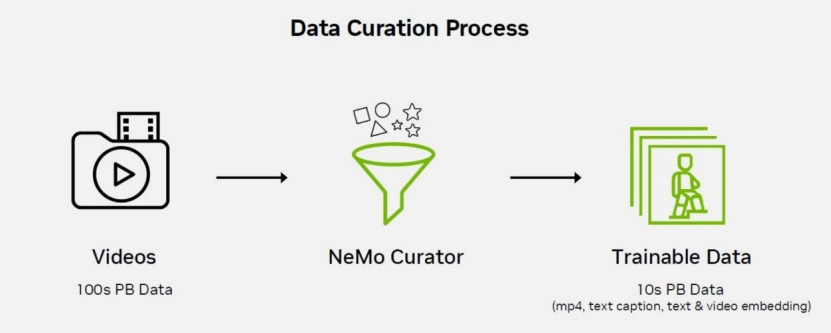
As large language models (LLMs) hit a training plateau in terms of the amount of text currently existing in the world that the models can swallow, inference becomes the priority for these models. What are World models? They are neural networks that understand the dynamics of the real world, including physics and spatial properties. They can use input data, text, image, video, and movement to generate videos that simulate realistic physical environments. Physical AI developers use world models to generate custom synthetic data or downstream AI models for training robots. Physical AI simplified is the system that bridges the digital and physical worlds, allowing machines to perceive, reason, and interact with their surroundings in real time. Humans and all animals interact with their surroundings unconsciously and without much thinking. We walk through spaces without hitting immovable objects, put our clothes on, drive, and navigate our world using our senses, and even optimize our own spaces to improve navigation. As of now, LLMs only navigate texts, images, and videos that they have as input and create outputs accordingly. World models that are trained to give machines "spatial intelligence" an internal understanding of physics, cause-and-effect, and 3D space. To train them, they ingest millions of hours of real-world video to understand motion and dynamics. By predicting subsequent events, the model can generate simulations, enabling robots to practice tasks virtually before attempting them physically. These learned capabilities are then fine-tuned for specific hardware configurations, such as autonomous vehicles or robotic appendages. Remember the saying “Data is the new Oil”? Well, now companies with the most video data (YouTube, Meta, Tesla, and maybe the ESPNs for sports) have an upper hand in this new paradigm. But, this is just the beginning, as the battle for wearables intensifies, the data that these devices generate becomes more valuable, because Meta glasses worn by millions means hours of real world footabe used to train spatial models. Maybe these wearables will become ubiquitous and relatively cheap as similar to social media, we will become the product that provides the training data (videos) to tech companies as we wear these so-called wearables and drive cars with multiple cameras. Major tech companies like NVIDIA, Google DeepMind, and Meta are developing world models to overcome current AI limitations, such as a lack of intuitive understanding of cause-and-effect and 3D space. Specialized startups like World Labs and AMI Labs are also working on this "spatial intelligence" to enable robots and autonomous systems to predict physical outcomes before acting, with applications in automotive, manufacturing, and entertainment industries. Startups and established companies are rushing to release wearables to get ahead of the next era. Snap just spun its wearable division into its own company, Google glasses are making a comeback, we all know Meta and RayBans devices, and OpenAI has been working on its AI device with Jony Ive. This is just the beginning. In the next edition, I’ll break down how spatial computing, world models, and Physical AI will shape decision-making, how machines won’t just answer questions, but tell us what to do next. 📚Learning CornerCourses & Educational Content
Meta vs. MicrosoftMicrosoft spends big, but Meta and Google are emerging as the winners, so far.
Why Meta looks like the real winner
Microsoft is spending aggressively on AI infrastructure, but most AI profits today still come from enterprise products like Azure AI and Copilot, not direct consumer monetization. AI-driven capex is rising faster than near-term margins. Meta, meanwhile, has already cracked AI monetization. AI-driven ranking and recommendation systems across Instagram, Facebook, and WhatsApp have increased engagement and ad efficiency, directly lifting ad impressions and revenue. Ads account for ~98% of Meta’s revenue, and AI is now core to that engine. Google is embedding AI directly into Search, Chrome (AI Mode), Workspace (Gemini), and Cloud. These upgrades improve retention, ad performance, and cloud growth, keeping AI tightly linked to revenue instead of standalone products. Meta is monetizing AI immediately, Google is reinforcing its ads + cloud flywheel, and Microsoft is still converting massive AI investment into consumer-level profit. 🧰 AI Tools of The DayPhysical AI
🚀 Showcase Your Innovation in the Premier Tech and AI Newsletter (link) As a vanguard in the realm of technology and artificial intelligence, we pride ourselves in delivering cutting-edge insights, AI tools, and in-depth coverage of emerging technologies to over 55,000+ tech CEOs, managers, programmers, entrepreneurs, and enthusiasts. Our readers represent the brightest minds from industry giants such as Tesla, OpenAI, Samsung, IBM, NVIDIA, and countless others. Explore sponsorship possibilities and elevate your brand's presence in the world of tech and AI. Learn more about partnering with us. You’re a free subscriber to Yaro’s Newsletter. For the full experience, become a paying subscriber. Disclaimer: We do not give financial advice. Everything we share is the result of our research and our opinions. Please do your own research and make conscious decisions.
|
Thursday, January 29, 2026
Meta Vs. Microsoft vs. Google








Monday, January 26, 2026
📹 90% of People Can’t Tell Real Video From AI
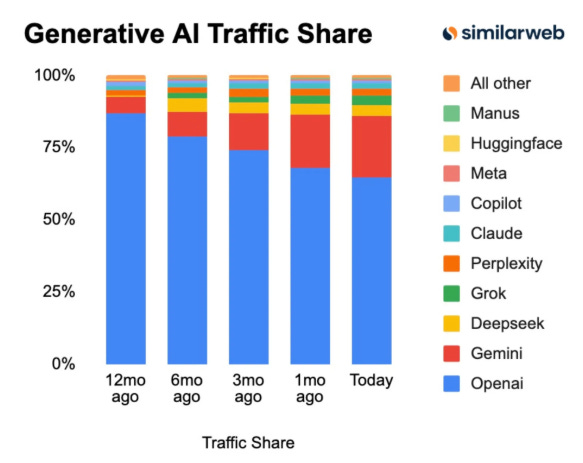
Gemini is quickly closing the gap with ChatGPT. Backed by Google’s massive distribution, it may only be weeks to challenge the top spot. Plus, AI-generated video is now so realistic that only ~10% of viewers can tell it apart from real footage. At the same time, AI is fundamentally changing how R&D is done, with faster cycles, lower costs, and fewer humans in the loop. More on this today. Stay curious.
📰 AI News and Trends
Other Tech News
Your Payment Processor Is Hiding Your Revenue Leaks
Most businesses think churn = cancellations. - That’s wrong. What your payment processor doesn’t clearly show you:
We built a real-time financial command center on top of Stripe and any payment processor that shows:
90% of People Can’t Tell Real Video From AI
AI video has crossed a major realism threshold. In a controlled study by Runway, 1,043 participants watched 20 short videos (10 real, 10 AI-generated) and nnly 9.5% (99 people) could reliably tell real from AI. Overall detection accuracy was 57.1%—barely above random guessing (50%). Where AI fooled people the most, viewers were in Animals & architecture videos, where detection fell below chance (45–47%), meaning people often thought AI videos were real. Humans (faces, hands, actions) are slightly easier to detect as models are creating more realistic human features, especially when looked closely, but still weak at 58–65% accuracy. AI video quality has improved exponentially since early 2023. What once took minutes to generate blurry clips and hands with 6-8 fingers now produces near-indistinguishable 5-second videos. The industry has hit a tipping point in terms of detection alone. But it also changes the way videos and even movie studios create footage. The technology will continue to become more powerful, fast and more realistic, to the point that entire high-quality movies will be created with powerful prompts. The winner may be the best storytellers with great imagination who know what people need emotionally.
📚Learning CornerCoding
AI Is Rewriting Product Development
Manufacturers are using AI to compress weeks or months of R&D into days and unlock solutions humans wouldn’t normally try.
AI seems to be quietly becoming a core R&D engine in chemicals, materials, and manufacturing, driving faster launches, lower costs, and sustainability gains. ChatGPT’s Lead Is Shrinking as Gemini Surges
The AI traffic race is tightening fast.
Why Gemini is winning
Still, ChatGPT dominates influence
Big picture
🧰 AI Tools of The Day
🚀 Showcase Your Innovation in the Premier Tech and AI Newsletter (link) As a vanguard in the realm of technology and artificial intelligence, we pride ourselves in delivering cutting-edge insights, AI tools, and in-depth coverage of emerging technologies to over 55,000+ tech CEOs, managers, programmers, entrepreneurs, and enthusiasts. Our readers represent the brightest minds from industry giants such as Tesla, OpenAI, Samsung, IBM, NVIDIA, and countless others. Explore sponsorship possibilities and elevate your brand's presence in the world of tech and AI. Learn more about partnering with us. You’re a free subscriber to Yaro’s Newsletter. For the full experience, become a paying subscriber. Disclaimer: We do not give financial advice. Everything we share is the result of our research and our opinions. Please do your own research and make conscious decisions.
|