
💰Big Tech’s $700B Capex Spree and Anthropic’s $900B Valuation QuestionPus: What Are AI Evals and Why Do They Matter?
The Anthropic valuation is raising a lot of skepticism, but it seems that when looking at the numbers and their revenue rate, it may make sense after all. We shall see. But anthropic is not the only one bringing in big numbers, the Capex spree of $700 is extremely large and still not satisfying demand. Where do we go from here? Let's discuss. Also, how to install your local LLM model for sensitive research and data, and which one to choose? We share a few. Stay Curious
📰 AI News and Trends
Other Tech News
Big Tech’s $700B Capex Spree and Anthropic’s $900B Valuation Question
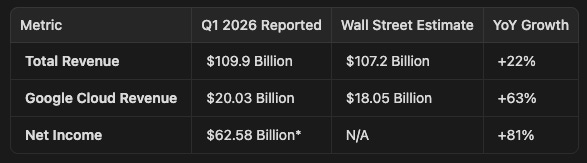
I am becoming a bit skeptical of the Anthropic’s valuations. Can they justify raising yet another $100B to reach almost the $1 Trillion valuation? How can they keep up with costs? Are their clients as loyal as they may think? I do understand that the artificial intelligence landscape in early 2026 is defined by staggering numbers. As Big Tech companies report their first-quarter earnings, the narrative is clear: the AI boom is generating massive revenue, but it requires an unprecedented scale of capital expenditure to sustain. At the center of this frenzy are the hyperscalers, Alphabet, Amazon, Microsoft, and Meta, and the frontier model builders like OpenAI and Anthropic. Alphabet’s blowout Q1 earnings were driven by Google Cloud, the collective $700 billion capital expenditure (capex) plans of Big Tech, and Anthropic’s reported pursuit of a $900 billion valuation. Alphabet’s Q1 2026: The AI Bet Pays OffAlphabet’s first-quarter 2026 earnings report served as a powerful vindication of its massive investments in AI. The company reported total revenue of $109.9 billion, a 22% year-over-year increase that comfortably beat Wall Street’s $107.2 billion estimate. The undisputed star of the quarter was Google Cloud. The division reported $20.03 billion in revenue, representing a staggering 63% year-over-year growth. This performance significantly outpaced analysts’ expectations of $18.05 billion and marked a sharp acceleration from the 48% growth seen in the previous quarter. Alphabet CEO Sundar Pichai highlighted that enterprise AI solutions have become the primary growth driver for Google Cloud for the first time. The company’s full-stack approach to AI is yielding results across the board, with Search queries hitting an all-time high and the Gemini Enterprise platform seeing a 40% quarter-over-quarter increase in paid monthly active users.
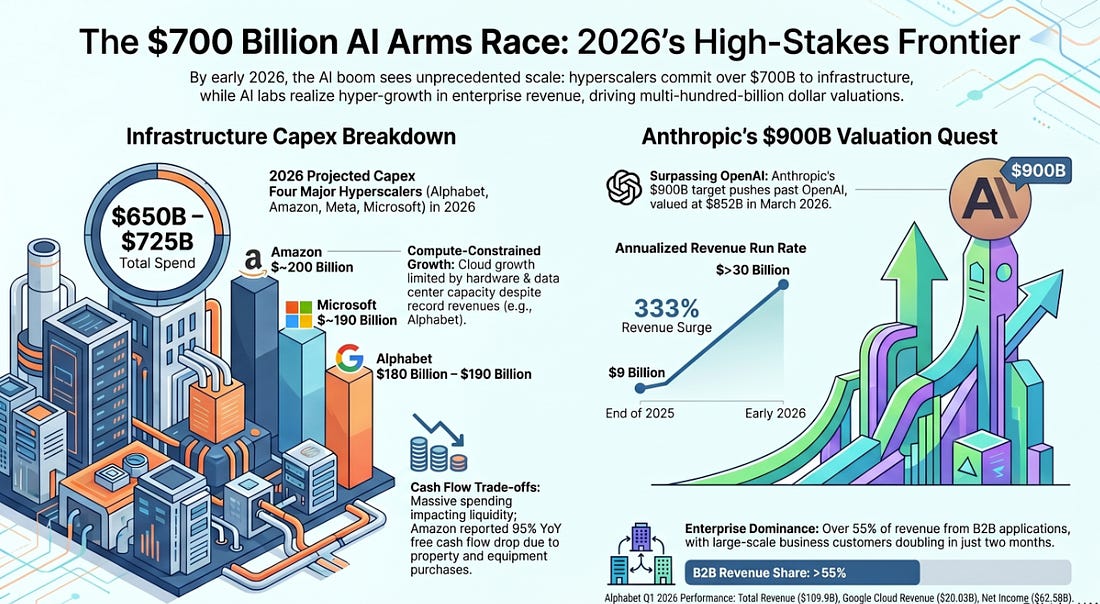
Despite the massive revenue surge, Google remains compute-constrained. “Our cloud revenue would have been higher if we were able to meet the demand,” Pichai noted during the earnings call. This constraint underscores the necessity of the massive infrastructure build-out currently underway across the industry. The $700 Billion Capex Arms RaceThe demand for AI compute has triggered what analysts are calling the largest concentrated infrastructure cycle in tech history. The four major hyperscalers, Alphabet, Amazon, Meta, and Microsoft, are collectively projected to spend between $650 billion and $725 billion on capital expenditures in 2026. This spending is almost entirely directed toward building out AI data center infrastructure, including land, power, buildings, servers, and highly sought-after AI accelerators (GPUs and TPUs). Breakdown of Big Tech 2026 Capex Guidance
The sheer scale of this investment is causing some unease among investors, with concerns about free cash flow and the potential for a “capital misallocation” if AI revenue doesn’t keep pace with infrastructure costs. For instance, Amazon reported that its free cash flow decreased to $1.2 billion for the trailing 12 months, a 95% drop year-over-year, driven primarily by a $59.3 billion increase in property and equipment purchases. However, tech executives remain resolute. Amazon CEO Andy Jassy compared the current environment to the early days of AWS, noting that “the faster AWS grows, the more short-term capex we’ll spend”. Microsoft CFO Amy Hood attributed part of their $190 billion capex forecast to a $25 billion impact from higher component prices, specifically citing soaring memory costs driven by the global AI hardware crunch. Anthropic’s $900 Billion Valuation: Justifiable or Froth?Against the backdrop of Big Tech’s infrastructure spending, frontier AI lab Anthropic is reportedly in talks to raise fresh capital at a valuation of more than $900 billion. If successful, this would push Anthropic past its chief rival, OpenAI, which was valued at $852 billion in March 2026. Anthropic’s valuation has skyrocketed over the past year. In February 2026, the company raised $30 billion at a $380 billion valuation. A jump to $900 billion in just a few months raises the critical question: Can the company justify this price tag? The Bull Case for $900 BillionThe justification for Anthropic’s soaring valuation rests on its explosive revenue growth, its deepening entrenchment in the enterprise sector, and the breakout success of its latest models.
The Valuation Math and IPO HorizonIf Anthropic is generating a $30 B to $40 B annualized revenue run rate, a $900 billion valuation implies a revenue multiple of roughly 22x to 30x. While high by traditional software standards, this multiple is actually a compression compared to earlier stages of the AI boom. The rapid growth in actual revenue is helping the company “grow into” its massive valuation. This fundraising push comes at a critical time. Anthropic is reportedly considering an initial public offering (IPO) as soon as October 2026. As Anthropic gains momentum, it is putting immense pressure on OpenAI, which is also expected to go public soon but has reportedly missed some revenue and user growth targets amid the fierce competition.
The hyperscalers are spending unprecedented sums because the enterprise demand for AI, evidenced by Google Cloud’s numbers and Anthropic’s $30B+ run rate, is materializing faster than expected. Anthropic’s potential $900 billion valuation, while staggering, is anchored by real, hyper-scaling enterprise revenue, the breakout success of models like Mythos, and massive compute resources secured through its Big Tech partnerships. Securing the capital and infrastructure to deploy AI at a global scale is the real AI war today. 📚Learning CornerWhat Are AI Evals and Why Do They Matter?
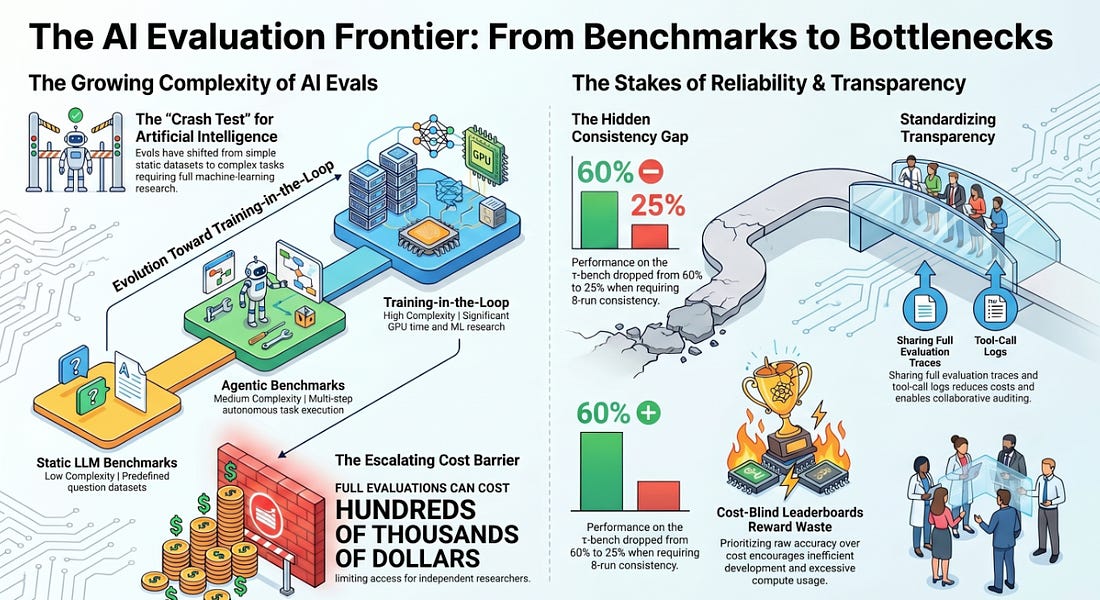
Artificial Intelligence evaluation (evals) is the critical process of testing and measuring the capabilities, reliability, and safety of AI models and agents. Similar to crash tests for vehicles or clinical trials for pharmaceuticals, evals provide standardized benchmarks to assess AI performance before and during deployment. According to the article “AI evals are becoming the new compute bottleneck” by Avijit Ghosh et al., AI evaluation has transformed from a relatively inexpensive process into a significant computational and financial challenge impacting the entire AI ecosystem. Types of AI EvalsAI evals have evolved to match the increasing complexity of AI systems:
Why Evals Are Crucial for EveryoneDespite their technical nature, AI evals have broad implications for society, governance, and the future of AI:
The Way ForwardThe escalating cost of evals necessitates a collaborative solution. Standardized documentation and data sharing are the most effective ways to reduce costs and enhance transparency. By publishing full evaluation traces, including prompts, scaffolds, and tool-call logs, researchers can build upon existing data, avoiding redundant testing. Initiatives like the EvalEval Coalition’s “Every Eval Ever” project aim to create a shared format for this data, promoting reuse and analysis within the community. In essence, AI evals are no longer a minor technical detail; they are the foundational infrastructure for measuring, trusting, and governing artificial intelligence. Ensuring their rigor, transparency, and accessibility is paramount for the safe and equitable advancement of AI. 🧰 AI Tools of The DayBest Open Source models for Local LLMs - As discussed yesterday with Dr. Sam Illinworth, getting an open source local LLM model for your personal research and queries is the best option. Here are 3 to consider:
🚀 Showcase Your Innovation in the Premier Tech and AI Newsletter (link) As a vanguard in the realm of technology and artificial intelligence, we pride ourselves in delivering cutting-edge insights, AI tools, and in-depth coverage of emerging technologies to over 55,000+ tech CEOs, managers, programmers, entrepreneurs, and enthusiasts. Our readers represent the brightest minds from industry giants such as Tesla, OpenAI, Samsung, IBM, NVIDIA, and countless others. Explore sponsorship possibilities and elevate your brand's presence in the world of tech and AI. Learn more about partnering with us. You’re a free subscriber to Yaro’s Newsletter. For the full experience, become a paying subscriber. Disclaimer: We do not give financial advice. Everything we share is the result of our research and our opinions. Please do your own research and make conscious decisions.
|






No comments:
Post a Comment