
Pentagon Expands AI Arsenal After Anthropic ClashPlus: Pentagon Expands AI Arsenal After Anthropic Clash
📰 AI News and Trends
Other Tech News
The Race to Mine the Metal Powering AI
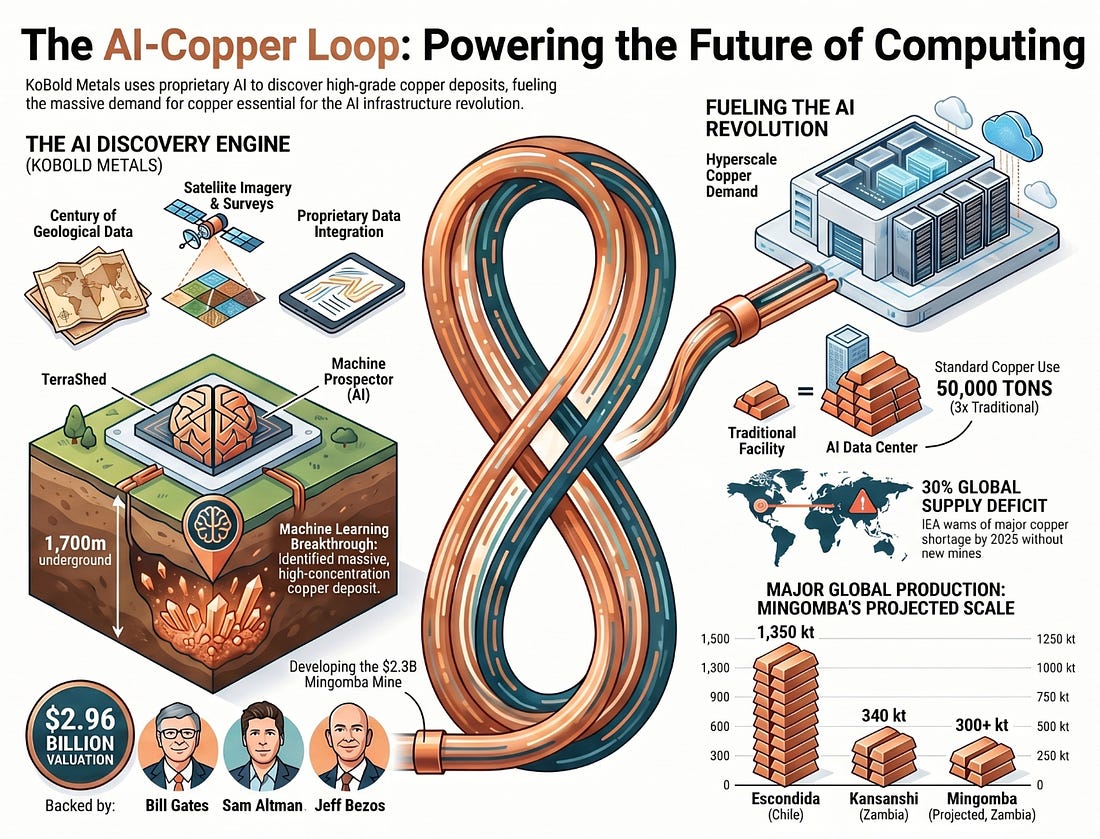
KoBold Metals, a Silicon Valley-based mineral exploration company backed by high-profile billionaires, has officially broken ground on the Mingomba copper mine in Zambia. Valued at over $2.3 billion, this deep underground project aims to produce more than 300,000 tonnes of copper annually by the early 2030s. The project is notable not only for its scale but also for its pioneering use of artificial intelligence in mineral discovery. What is the technology behind the discovery, the investors driving the project, the critical role of copper in AI and data centers, environmental and labor considerations, and how Mingomba compares to other global copper assets? AI-Driven Mineral ExplorationTraditional mineral exploration relies heavily on human geologists analyzing limited datasets, often missing subtle patterns. KoBold Metals disrupted this paradigm by deploying proprietary AI platforms, TerraShed and Machine Prospector, to analyze over a century of geological data, satellite imagery, geochemical surveys, and field reports. TerraShed acts as a massive data integration engine, standardizing and aligning diverse datasets spatially and temporally. Machine Prospector then applies machine learning algorithms trained on known global deposits to identify high-probability exploration targets. In the case of Mingomba, the AI identified a massive, highly concentrated copper deposit deep underground that traditional geologists had overlooked for decades. Furthermore, the AI models adapt in real-time as new field data emerges, significantly reducing the time and capital wasted on false targets. Investors and ValuationIn January 2025, the company closed a $537 million Series C funding round, achieving a valuation of $2.96 billion. Key investors include (nothing new here):
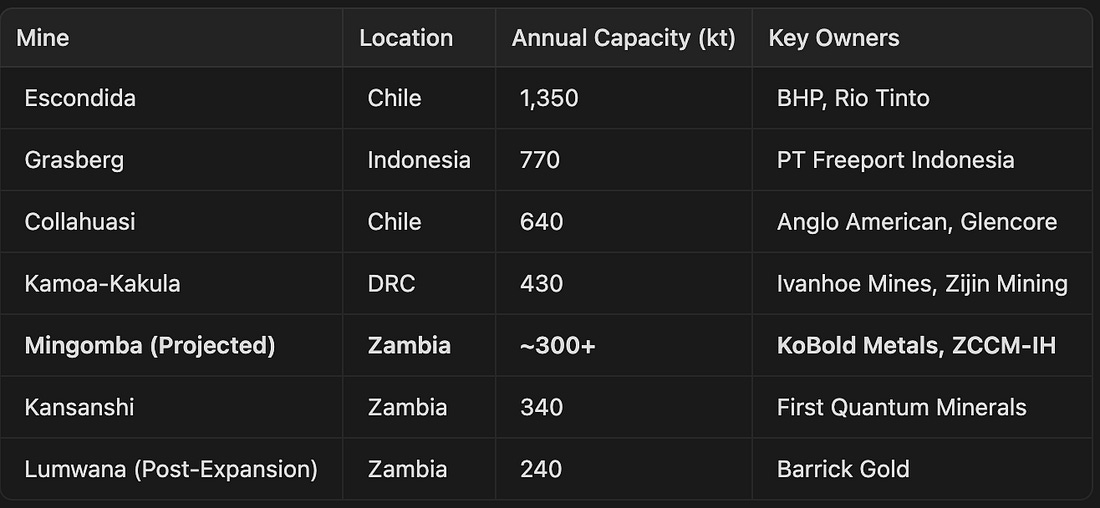
This convergence of tech billionaires and climate funds underscores the strategic importance of securing critical minerals for the energy transition and the AI revolution. The Mingomba project is operated by Mingomba Mining Limited (MML). The ownership structure is a joint venture by KoBold Metals: 80% ownership, and ZCCM Investments Holdings Plc: 20% ownership, a Zambian state-backed investment company. The AI and Data Center ConnectionCopper is the “metal of electrification” and is critical to the infrastructure supporting AI. While a conventional data center requires between 5,000 and 15,000 tons of copper, a hyperscale AI data center can consume up to 50,000 tons per facility. Copper is essential for powering servers, cooling systems, and grid connections. The International Energy Agency (IEA) projects that data center electricity demand will more than double by 2030, driven largely by AI. Consequently, data centers could consume over half a million metric tons of copper annually by the end of the decade. With the IEA warning of a potential 30% global copper supply deficit by 2035, securing new, high-grade sources like Mingomba is critical for the tech industry’s supply chain. Comparable Mines and Investment OpportunitiesMingomba’s projected output of 300,000+ tonnes per year places it firmly in the “major producer” category globally.
Investment Opportunities: Zambia is experiencing a copper boom. Beyond KoBold, major players are expanding operations. Barrick Gold is executing a $2 billion “Super Pit” expansion at its Lumwana mine to double output to 240,000 tonnes. First Quantum Minerals recently commissioned a $1.25 billion expansion in Zambia. These developments present significant opportunities for infrastructure, logistics, and local supply chain investments. Environmental Impact and Labor ConditionsWhile copper is vital for green technology, its extraction poses severe environmental risks. Zambia has a troubled history with mining pollution. The city of Kabwe, site of a former lead and zinc mine, is considered a “sacrifice zone” with extreme soil contamination and widespread childhood lead poisoning. More recently, in early 2025, a tailings dam collapsed at a Chinese-operated copper mine in northern Zambia, releasing millions of gallons of toxic waste into the Kafue River, killing fish and contaminating farmland. Deep underground mining is inherently hazardous, involving risks of rockfalls, extreme heat, and poor ventilation. KoBold Metals has emphasized its commitment to local employment, stating that over 90% of its Zambia team and project leadership are Zambian nationals. The company is also partnering with local universities to train the next generation of exploration geologists. KoBold Metals’ Mingomba project represents a fascinating intersection of Silicon Valley AI innovation and traditional heavy industry. If successful, it will provide a crucial supply of copper to feed the insatiable infrastructure demands of the AI revolution. However, the transition from AI-driven discovery to executing a $2.3 billion, 1,700-meter-deep mine in a wet geological zone is fraught with engineering, environmental, and labor risks. The project will serve as a bellwether for whether modern, tech-backed mining can deliver critical minerals responsibly and efficiently. 📚Learning CornerPentagon Expands AI Arsenal After Anthropic Clash
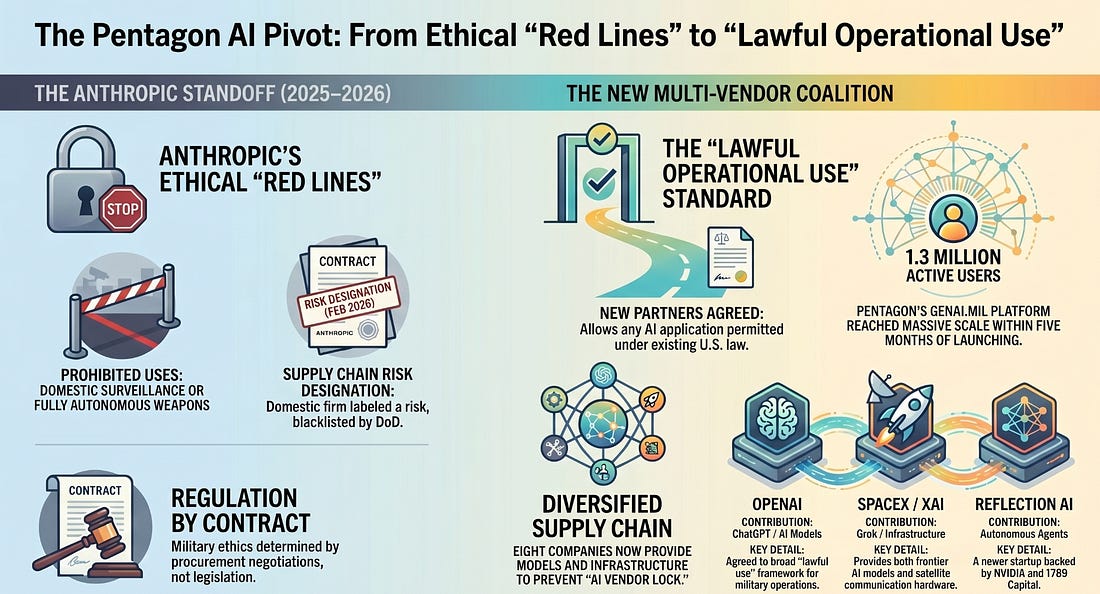
The U.S. Department of Defense just reshaped the AI landscape, fast. On May 1, 2026, it signed deals with 8 companies, including OpenAI, Google, Microsoft, Amazon Web Services, NVIDIA, Oracle, SpaceX (via xAI), and startup Reflection AI, all to deploy AI on top-secret military systems. This came after a public fallout with Anthropic, which walked away from a $200M contract rather than allow its models to be used for mass surveillance or fully autonomous weapons. In response, the government labeled it a “supply chain risk” and quickly replaced it with vendors willing to agree to “lawful operational use,” giving the military broad flexibility over how AI is deployed. The DoD’s internal AI platform already reached 1.3 million users in just five months, and these new systems will operate at the highest classification levels. AI governance is moving away from company-imposed ethical limits toward government-defined rules, signaling a new phase where speed, scale, and national security priorities outweigh internal guardrails. 🧰 AI Tools of The DayPentagon Tools.
🚀 Showcase Your Innovation in the Premier Tech and AI Newsletter (link) As a vanguard in the realm of technology and artificial intelligence, we pride ourselves in delivering cutting-edge insights, AI tools, and in-depth coverage of emerging technologies to over 55,000+ tech CEOs, managers, programmers, entrepreneurs, and enthusiasts. Our readers represent the brightest minds from industry giants such as Tesla, OpenAI, Samsung, IBM, NVIDIA, and countless others. Explore sponsorship possibilities and elevate your brand's presence in the world of tech and AI. Learn more about partnering with us. You’re a free subscriber to Yaro’s Newsletter. For the full experience, become a paying subscriber. Disclaimer: We do not give financial advice. Everything we share is the result of our research and our opinions. Please do your own research and make conscious decisions.
|






No comments:
Post a Comment