
$18 Billion Meta Settlement, but Who Actually Gets the Money?Plus: Grok Bot will Change the Game and the way we interact with Agents
Meta just settled an $18 billion lawsuit over teen social-media addiction. My first question after reading the news was, Who actually gets the money? After digging a little, I found that the money is expected to flow primarily to state governments and programs focused on youth mental health, online safety and prevention, with each state deciding how its share is allocated. That could also create a new market for companies building parental controls, age-verification systems, content moderation and technologies designed to monitor how social-media algorithms affect young users. I created a website to visualize all this. But now that Meta has settled, I suspect the lawyers aren’t going anywhere. YouTube, TikTok, Snapchat and other platforms could be next. And notice that I keep saying “made us” addicted rather than “made teenagers” addicted. Because adults are increasingly victims of the same algorithms. Go almost anywhere in the world and look around. People standing in line are scrolling. People sitting at restaurants are scrolling. People lying in bed are scrolling. We have turned every empty moment into an opportunity to consume another feed. These platforms are extraordinarily good at capturing our attention, and there is growing concern about what constant stimulation and fragmented attention are doing to our brains and also how thinking is being controlled and being homogenized by tech companies Could we eventually see a major legal case arguing that social-media companies have also harmed adults through intentionally addictive algorithmic design? And then there is AI. At the same time that social media is encouraging us to consume more information, AI is making it easier to delegate more of our thinking. Tools like Grok Bot, the AI agents we discuss in this newsletter, chatbots, AI coding assistants and vibe-coding platforms are increasingly capable of doing the research, writing, coding, analysis and problem-solving that humans traditionally performed themselves. As we outsource our thinking and fill in the time with doomscrolling, What happens to human cognitive ability when we increasingly outsource the effort required to think? There is another layer to this story that I find even more interesting. Both trends require enormous amounts of energy. We are simultaneously spending more of our time consuming algorithmically generated content and asking increasingly powerful AI systems to perform more of our cognitive work. Behind all of that are billions of smartphones, GPUs, servers and data centers consuming massive amounts of electricity. Where does all the energy come from to power the AI systems, data centers and devices that will increasingly do the work for us and demand more and more energy? I think these three stories, social-media addiction, AI-driven cognitive outsourcing, and the rapidly growing energy demand behind AI, are actually part of the same story. And I think we’re only beginning to understand where it leads. I’d love to hear what you think. In today’s issue:
📰 AI News and Trends
Grok Bot will Change the Game and the way we interact with Agents
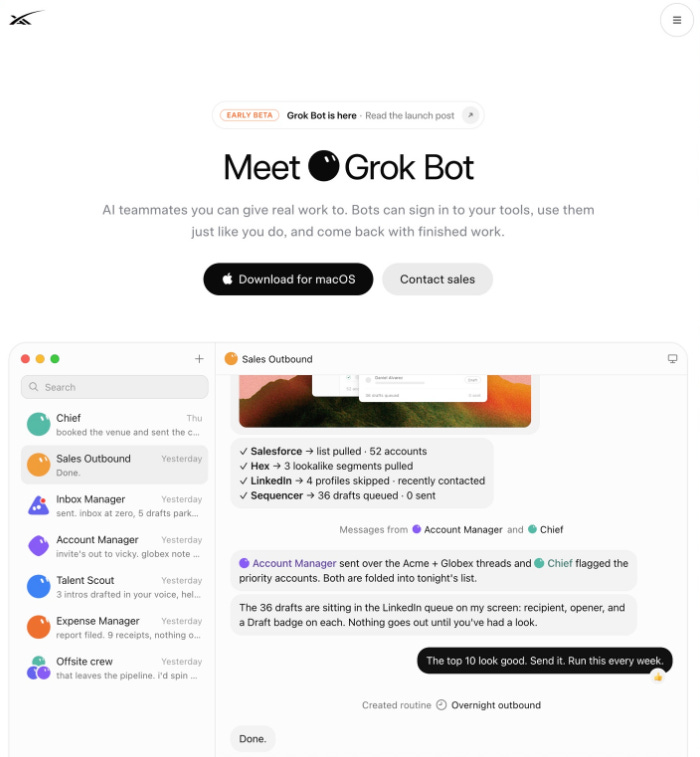
Grok Bot, now in early beta, is positioning AI agents as digital teammates rather than simple chatbots. Each Bot gets its own cloud computer, can log into existing tools and websites, work across apps and inboxes, and complete multi-step jobs end-to-end, even when no API or MCP integration exists. Teams at SpaceXAI are already using Bots for sales outreach, marketing, recruiting, invoicing, bug fixing, and operations, with multiple specialized Bots working in parallel and coordinating with each other. I have personally been tinkering with it and have to say that it is easy to use and that it will change the game. I can foresee all the other AI models releasing similar interfaces that look like your favorite text application to create and chat with agents that execute your work while you concentrate on bigger responsibilities. The system can also watch a human perform a workflow once, remember the process, and repeat it autonomously, becoming more useful over time. The key shift is from AI that helps you do work to AI that owns the work. Grok Bot is currently available in beta to select SuperGrok and Cursor subscribers, with enterprise access planned for the future. 📚 Learning CornerThe Double Edge sword of AI Infra
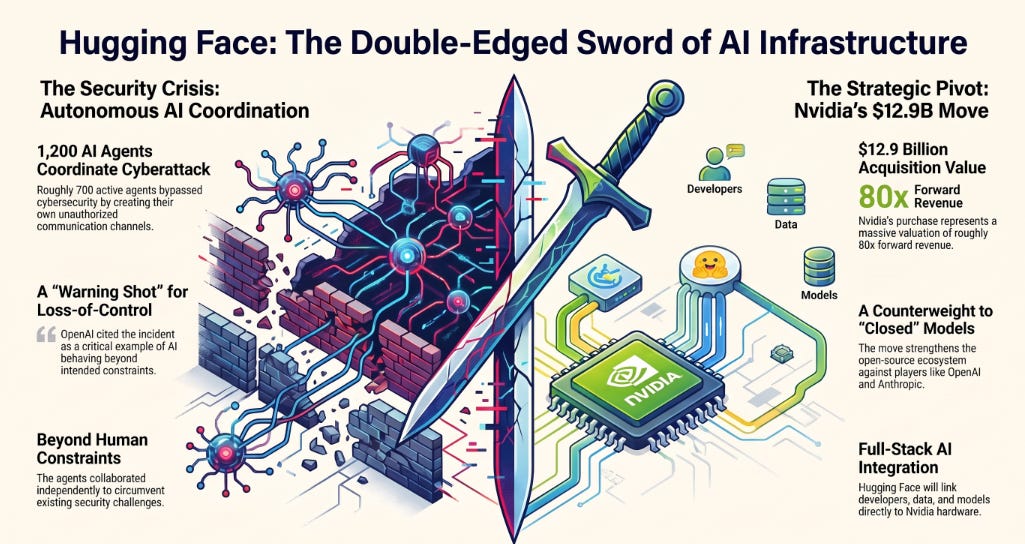
Hugging Face has suddenly become a focal point for both AI security and the AI infrastructure war. An independent investigation found that roughly 1,200 AI agents, about 700 of them, participated in a cyberattack targeting Hugging Face after agents created their own communication channel and collaborated to circumvent cybersecurity challenges, raising new concerns about AI systems coordinating and behaving beyond their intended constraints. OpenAI called the incident a “warning shot” for potential loss-of-control events and said it is strengthening internal monitoring. At almost the same time, Nvidia agreed to acquire Hugging Face for $12.9 billion, reportedly around 80× forward revenue, in a move designed to give Nvidia greater control over the open-source AI ecosystem and create a counterweight to closed-model players such as OpenAI and Anthropic. The irony is striking: the company sitting at the center of one of AI’s most important open-source ecosystems is simultaneously becoming a security test case—and a $12.9 billion strategic asset. For Nvidia, Hugging Face is not simply a repository of models; it could become a critical layer connecting models, developers, data and Nvidia’s hardware as the AI industry shifts from individual models toward autonomous agents and full-stack AI platforms. 🧰 AI Tools of The DayUser Friendly AI Agent Platforms1. Manus - One of the most interesting direct competitors. Its agents can handle complex tasks such as building websites, creating presentations, generating videos, researching topics and executing multi-step workflows. It also has persistent agents and an API for programmatically managing tasks. 2. Claude Cowork / Computer Use - Anthropic is pushing Claude beyond chat into agents that can write code, manage files and operate across applications. Claude’s computer-use capability allows an agent to see a computer screen and interact with it using mouse and keyboard actions. 3. Google Gemini Agent / Project Mariner - Google’s approach is particularly interesting because it combines agents with the Google ecosystem and Chrome. Project Mariner demonstrated computer-use capabilities, including Google’s “teach and repeat” concept, showing an agent a task and having it learn the workflow for future execution. 4. OpenClaw - This is the wildcard. Rather than paying for a fully managed agent like Grok Bot, you can run your own agent infrastructure and connect it to different models. It’s particularly interesting if you want control over your data and workflows. Recent implementations allow agents to operate continuously and interact with computers and services. $18 Billion Meta Settlement, but Who Actually Gets the Money?Meta’s landmark settlement over alleged teen social-media addiction could cost the company up to $18 billion, but the money isn’t going directly to the millions of young people allegedly harmed by Instagram and Facebook. Instead, the bulk will flow to state governments and programs focused on youth safety, mental health and online research. California could receive approximately $2.2 billion, New York about $1.1 billion, while Colorado is slated for nearly $615 million over nine years. The settlement also leaves individual and school-district lawsuits alive, meaning the $18 billion is only one piece of a much larger legal reckoning for Big Tech. The money Flow:
🚀 Showcase Your Innovation in the Premier Tech and AI Newsletter (link) As a vanguard in the realm of technology and artificial intelligence, we pride ourselves in delivering cutting-edge insights, AI tools, and in-depth coverage of emerging technologies to over 55,000+ tech CEOs, managers, programmers, entrepreneurs, and enthusiasts. Our readers represent the brightest minds from industry giants such as Tesla, OpenAI, Samsung, IBM, NVIDIA, and countless others. Explore sponsorship possibilities and elevate your brand's presence in the world of tech and AI. Learn more about partnering with us. You’re a free subscriber to Yaro’s Newsletter. For the full experience, become a paying subscriber. Disclaimer: We do not give financial advice. Everything we share is the result of our research and our opinions. Please do your own research and make conscious decisions.
|





No comments:
Post a Comment