Kalshi and Polymarket Are Flying High. Can They Outrun the Regulators?Plus: Kalshi and Polymarket Are Flying High. Can They Outrun the Regulators?
I finally downloaded Kalshi this weekend, and got a crash course in what a real dopamine rush feels like. Social media has nothing on these prediction platforms. We break down how Kalshi and Polymarket are performing and the regulatory headwinds they’re facing, among other issues. We also dig into the top 100 consumer AI apps for March 2026, and the question that’s becoming impossible to ignore: Can the US actually control who gets to build AI infrastructure, or is that ship already sailing? Let’s get into it. Stay curious.
📰 AI News and Trends
Other Tech News
The US Moves to Control Who Gets to Build AI InfrastructureThe US Commerce Department is drafting regulations that would require U.S. approval for nearly all global exports of AI chips from companies such as Nvidia and AMD. Under the proposed framework, buyers of smaller quantities (under 1,000 GPUs) would undergo a simple review process, while larger data center projects would require pre-clearance and may be subject to conditions such as business disclosures or government site visits. The biggest deployments, over 200K GPUs, would require host governments to make security commitments and matching investments in American AI. The framework is still in draft form and faces pushback even within the Trump administration, which has distanced itself from Biden’s prior “AI diffusion rule” while not yet finalizing a replacement. Can the United States be the de facto gatekeeper of global AI infrastructure?Yes, the US can, but it’s not that simple:
And NO, because:
The deeper tension is that the US wants two things simultaneously: to be the world’s AI supplier and to use that position as geopolitical leverage. Those goals can conflict. Push too hard on conditions and countries diversify away; be too permissive, and you lose the leverage entirely. Whether Washington can thread that needle is genuinely unclear. 📚Learning Corner
The Top 100 Consumer AI apps
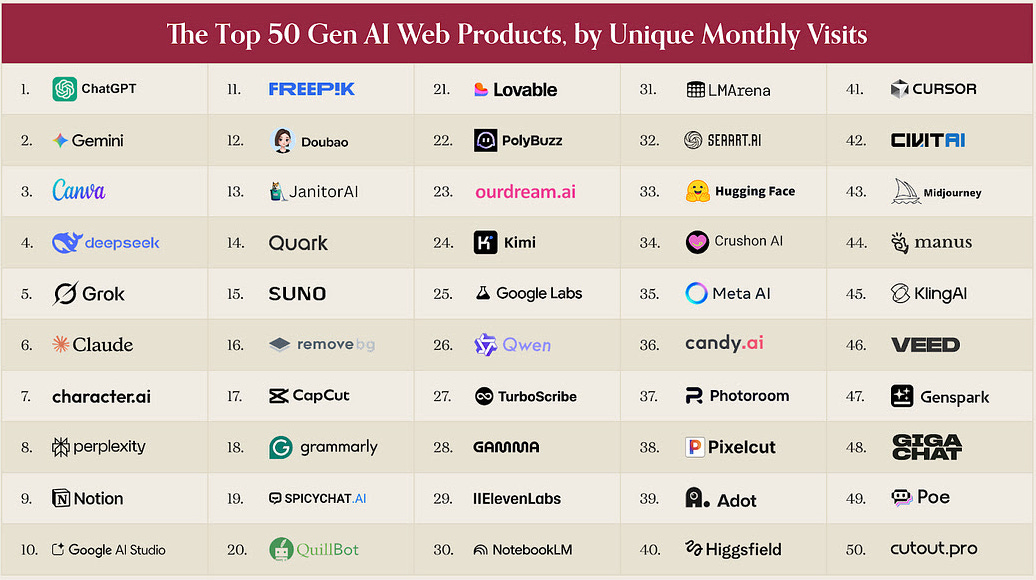
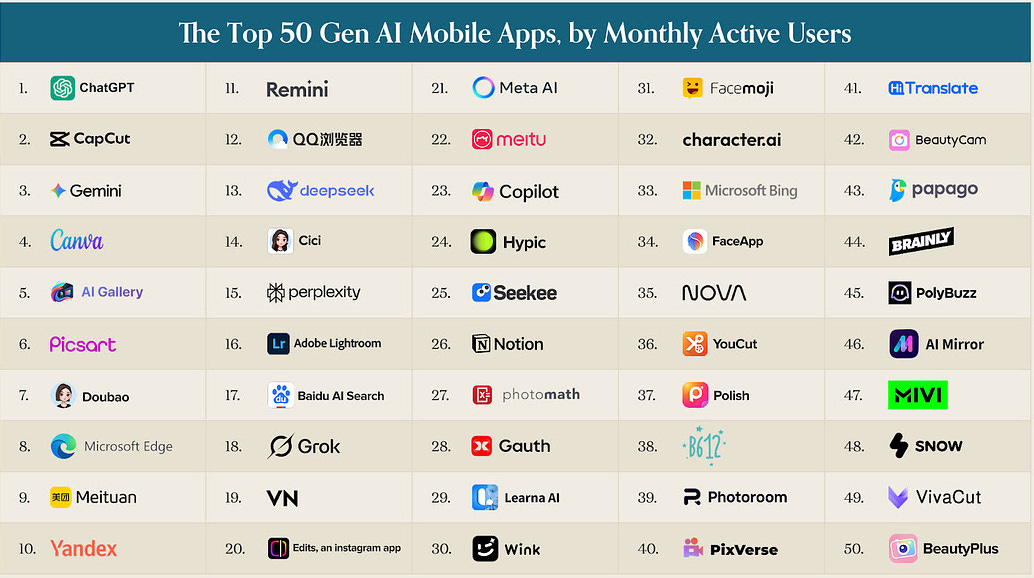
The latest ranking of the top 100 consumer AI apps paints a picture of a maturing market. For the first time, the list now includes mainstream tools like CapCut, Canva, and Notion, where AI has quietly become central to the core experience rather than a bolt-on feature. ChatGPT still dominates, with 900 million weekly active users, but competitors are closing in on specific fronts. Claude’s paid subscribers grew over 200% year-over-year, Gemini had a breakout year on the creative side, and roughly 20% of ChatGPT users now also use Gemini in any given week. The platforms are diverging in strategy. OpenAI is chasing the consumer super-app (shopping, travel, health), while Anthropic is doubling down on power users, developers, knowledge workers, and professionals. Geographically, the market is split into three. Western tools, a Chinese ecosystem anchored by DeepSeek and Doubao, and an emerging Russian pole built around Yandex and Sber. The US ranks just 20th in per-capita AI adoption; Singapore, UAE, and Hong Kong lead.
Creative tools have shifted from image-dominated to a broader mix of video, music, and voice, with Chinese video models leading on quality and standalone image generators losing ground to bundled features inside ChatGPT and Gemini. Agents are the new frontier. Vibe coding tools like Lovable and Replit are holding their audiences, while horizontal agents, OpenClaw (acquired by OpenAI), Manus (acquired by Meta for ~$2B), and Genspark, are starting to let everyday users hand off complex tasks entirely. The next six months will reveal whether consumers consolidate around one AI agent or keep juggling several. Kalshi and Polymarket Are Flying High. Can They Outrun the Regulators?
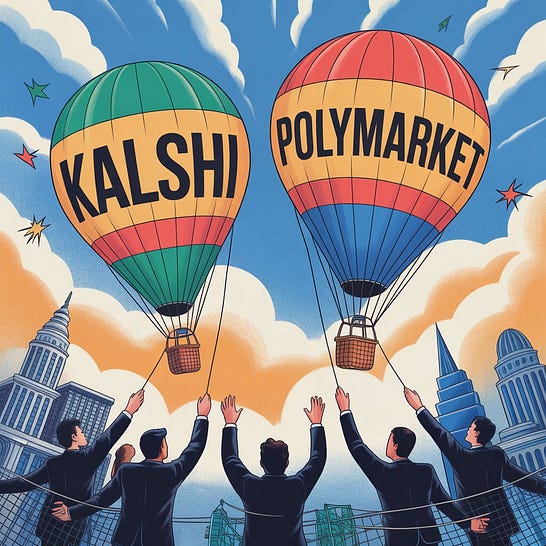
I’m probably late to the party, but I finally downloaded Kalshi this weekend after a conversation with some cousins-in-law in their mid-20s, and it was a good reminder of why it pays to listen to younger people when trying to understand where markets are heading. Opening the app for the first time was a jolt. I thought social media was addictive. I hadn’t seen anything yet. The range of what you can trade on is staggering: sports, politics, the economy, the weather. Some markets resolve in seconds. Others play out over months. The company’s CEO insists it’s not a betting platform, but when you’re staring at a screen full of live odds, and your finger is hovering over a position, that distinction feels academic. I had to actively stop myself from putting money in. That experience alone tells you everything you need to know about why regulators are paying close attention. It’s not just the financial implications of mainstream prediction markets; it’s the design. These apps are built to pull you back in, and they’re very good at it. The dopamine loop is real, and it’s been refined. We may look back at social media as the warm-up act. Kalshi and Polymarket, the two biggest players in the space, are both in early talks with investors about raising new rounds at valuations near $20 billion each, roughly double where they were just a few months ago. Kalshi, which is already live in the US and recently crossed a $1.5 billion annualized revenue run rate, was last valued at $11 billion after raising $1 billion in December from Sequoia and Paradigm. Polymarket, still blocked for US users but planning a domestic launch this year, was last valued at $9 billion following a deal with NYSE parent Intercontinental Exchange. The growth is real, but so is the turbulence. Both platforms are facing a bipartisan bill in Congress that would ban markets on war, geopolitical events, and sports. They’re also under fire for aggressive college marketing tactics, including a case where Polymarket gave a fraternity cash in exchange for recruiting new users, and a wave of suspicious trades around Jeff Bezos’ Super Bowl whereabouts, placed by members of his stepson’s fraternity. Prediction markets have genuine utility as forecasting tools and are growing fast, but their push into sensitive topics and college campuses is drawing exactly the kind of regulatory attention that could reshape the business before it fully matures. 🧰 AI Tools of The DayEthical and Conversational AI
🚀 Showcase Your Innovation in the Premier Tech and AI Newsletter (link) As a vanguard in the realm of technology and artificial intelligence, we pride ourselves in delivering cutting-edge insights, AI tools, and in-depth coverage of emerging technologies to over 55,000+ tech CEOs, managers, programmers, entrepreneurs, and enthusiasts. Our readers represent the brightest minds from industry giants such as Tesla, OpenAI, Samsung, IBM, NVIDIA, and countless others. Explore sponsorship possibilities and elevate your brand's presence in the world of tech and AI. Learn more about partnering with us. Disclaimer: We do not give financial advice. Everything we share is the result of our research and our opinions. PLEASE do your own research and make conscious decisions. The web3 space can be highly volatile and risky.
|
Monday, March 9, 2026
Kalshi and Polymarket Are Flying High. Can They Outrun the Regulators?






Subscribe to:
Post Comments (Atom)
No comments:
Post a Comment