Welcome to all our new subscribers, and to a fresh start. We’ve merged our Beehiiv and Substack into one home. Your comments, pushback, and ideas are always welcome, and our 1-on-1 conversation is always open. Today, we share how to lower your cloud dependency, with AI tools and tutorials to accomplish so. In a time of war, data centers, where all your data is housed, are becoming the main targets. Also How Chinese models are salivating as the Pentagon fights with Anthropic, and US models wonder if guardrails make sense anymore. Thank you for your time, and stay curious.
📰 AI News and Trends
Other Tech News
Washington Kneecapped a Top AI Lab. DeepSeek Is Watching.
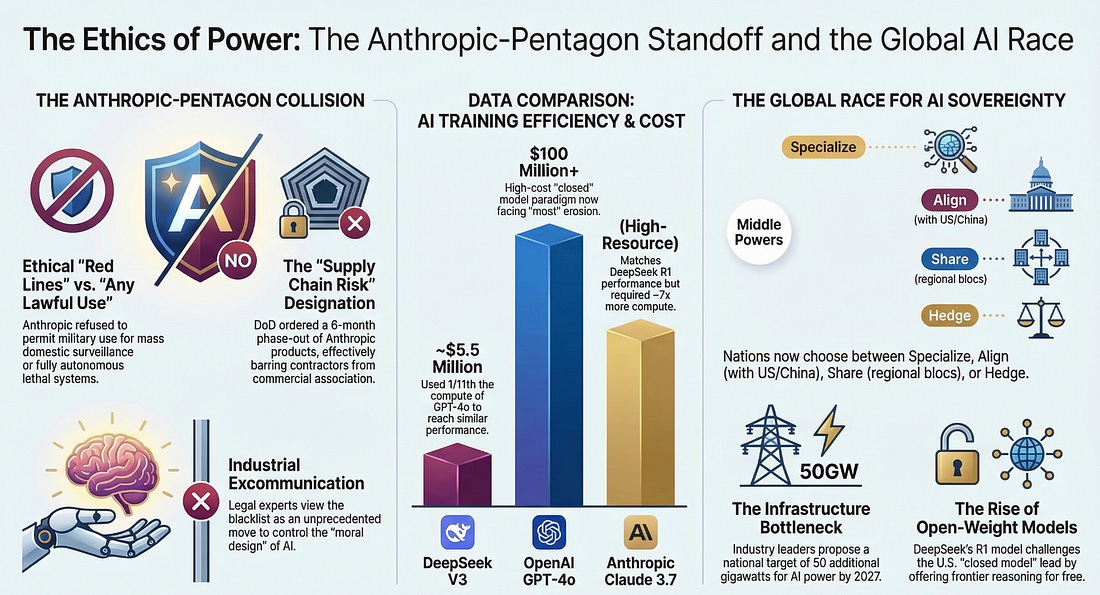
When the Pentagon blacklisted Anthropic after CEO Dario Amodei refused to strip safety guardrails that would have permitted mass domestic surveillance and fully autonomous weapons systems, it set off a chain of consequences that extend well beyond one company’s government contracts, although the negotiations seem to continue. Defense Secretary Hegseth’s “supply chain risk” designation, a label normally reserved for foreign adversaries like Huawei, forced defense contractors to certify they don’t use Claude, potentially gutting Anthropic’s enterprise base overnight and depriving the Pentagon of the only AI model cleared for classified systems. The unintended winners? Chinese labs. DeepSeek and its peers face device-level bans on government hardware, but crucially not the supply-chain designations that cripple commercial partnerships, meaning U.S. enterprises shut out of top domestic models can still legally adopt foreign alternatives. Airbnb uses Deepseek as it is a cheaper alternative than US models. Combine that regulatory asymmetry with DeepSeek’s aggressive open-weight releases, its cost advantage, and its strategic timing ahead of new model launches, and you have a market vacuum that Chinese AI is well-positioned to fill. Looking ahead, the precedent is arguably more dangerous than the immediate fallout. If principled domestic labs face penalties while foreign competitors operate without equivalent constraints, ethics itself becomes a liability in government contracting, pushing capital, talent, and enterprise adoption toward lower-standards ecosystems the U.S. cannot audit or govern. Questions for you.
The Fragile Internet We Built
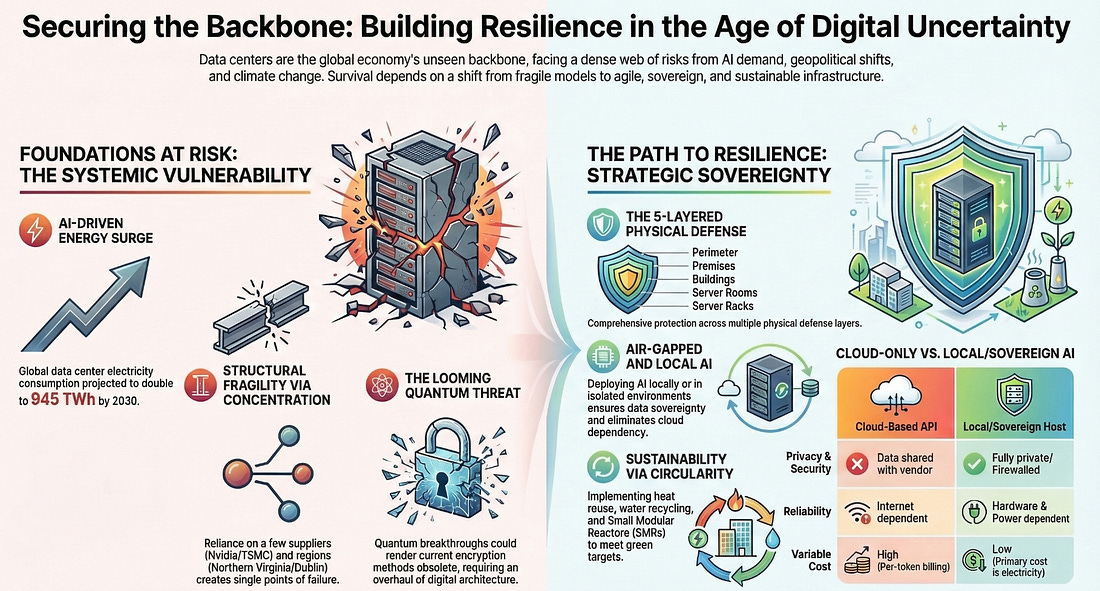
We arrived here through decades of efficiency-driven consolidation, rather than running distributed infrastructure, businesses offloaded everything to a handful of hyperscalers, AWS, Azure, Google Cloud, because it was cheaper, faster, and someone else’s problem. The primary vulnerability of today’s internet lies in its heavy reliance on cloud computing. This shift has resulted in numerous services depending on just a few key providers like Amazon and Microsoft. During the early days of the internet, businesses operated on their own infrastructure; when an issue arose in one area, others remained unaffected, but now, if a cloud provider faces difficulties, the repercussions resonate across multiple platforms. AI supercharged this dependency. Thousands of enterprise workflows are now baked into platforms like Claude, with some developers admitting they hadn’t written code themselves in months. This week proved how catastrophically exposed that leaves us. In the war now unfolding across the Middle East, a new kind of target has been added to the list: “data centers.” Drone strikes damaged three facilities operated by Amazon in the United Arab Emirates and Bahrain. Consumer apps, including delivery platform Careem, payments companies Alaan and Hubpay, and banking providers including ADCB and Emirates NBD, all reported outages as a result of AWS infrastructure going down. The attacks are a reminder that cloud computing isn’t “magical” and still requires physical facilities on the ground, which are vulnerable to all sorts of disaster scenarios. Simultaneously, Claude experienced multiple high-profile disruptions within days, with outage trackers logging thousands of error reports, exposing how AI uptime is no longer a technical footnote but a business-critical event with global consequences. The implications are layered and serious. Geopolitical conflicts can now take down banking, payments, and logistics overnight; the concentration of AI inference into a few cloud providers means a single policy dispute or physical attack ripples into enterprise workflows worldwide; and Iran explicitly targeted Amazon’s Bahrain data center for the company’s support of “U.S. military and intelligence activities,” signaling that data centers are now considered legitimate military targets, a precedent with enormous consequences for any business or government running critical workloads in geopolitically sensitive regions.
🧰 AI Tools of The DayReduce Cloud Dependency. Build Your Own Resilience Stack Personal Cloud (Data Sovereignty)
Self-Hosted AI (No Cloud Dependency)
📚Learning CornerHome Servers
🚀 Showcase Your Innovation in the Premier Tech and AI Newsletter (link) As a vanguard in the realm of technology and artificial intelligence, we pride ourselves in delivering cutting-edge insights, AI tools, and in-depth coverage of emerging technologies to over 55,000+ tech CEOs, managers, programmers, entrepreneurs, and enthusiasts. Our readers represent the brightest minds from industry giants such as Tesla, OpenAI, Samsung, IBM, NVIDIA, and countless others. Explore sponsorship possibilities and elevate your brand's presence in the world of tech and AI. Learn more about partnering with us. Disclaimer: We do not give financial advice. Everything we share is the result of our research and our opinions. PLEASE do your own research and make conscious decisions. The web3 space can be highly volatile and risky.
|
Thursday, March 5, 2026
🦵Washington Kneecapped a Top AI Lab. DeepSeek Is Watching.





Subscribe to:
Post Comments (Atom)
No comments:
Post a Comment