Quantum computing is getting a lot more sophisticated, but can it hack cryptographic messages and crypto wallets as some fear? Also, how companies are preparing for the post-quantum transition. What is here and is a real threat are AI music generators; they are becoming faster and sound more realistic. How can labels and streaming services protect their businesses? We share today. Let’s get into it. Stay curious.
📰 AI News and Trends
Other Tech News
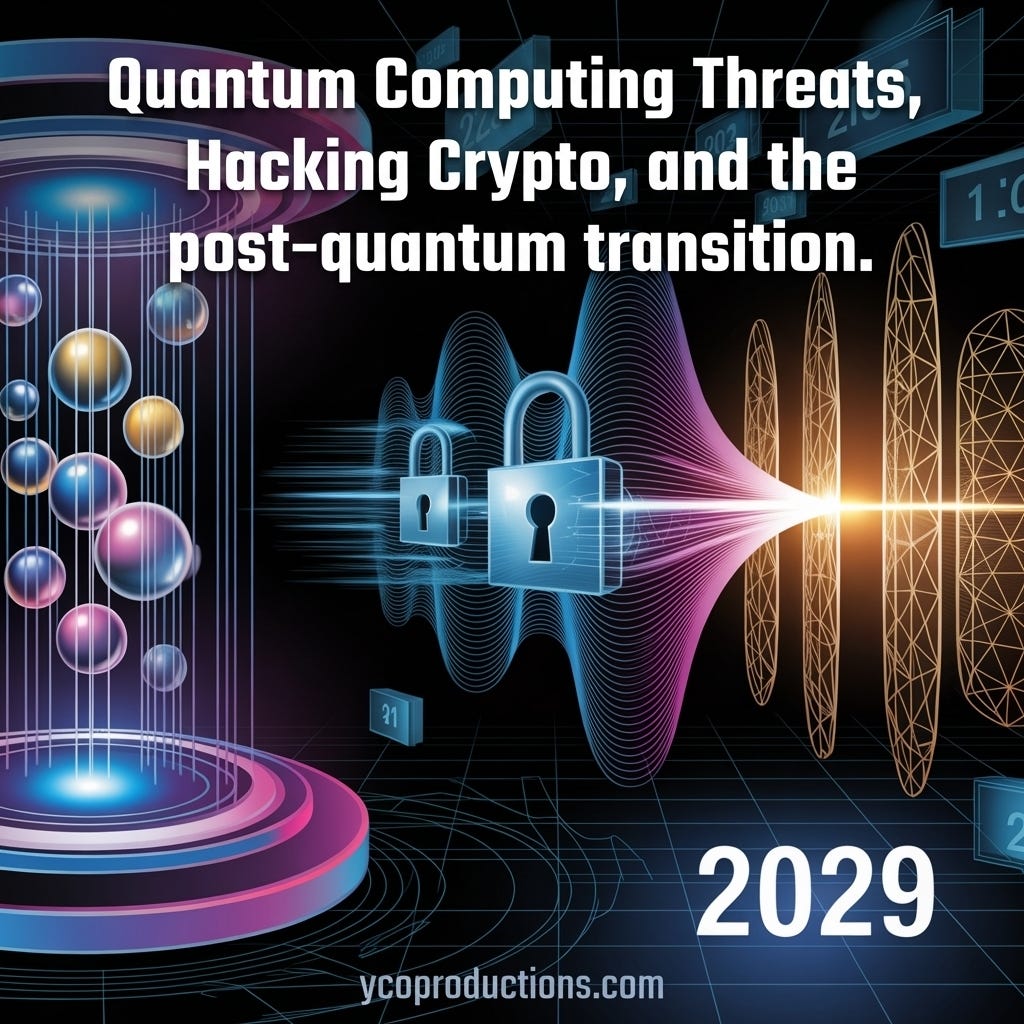
Quantum Computing Threats, Hacking Crypto, and the post-quantum transition.
Quantum computing represents a paradigm shift in technology, promising to solve complex problems that are currently intractable for classical supercomputers. However, this immense computational power also poses an existential threat to the cryptographic foundations of the modern internet. Recently, Google accelerated its timeline to defend against this threat, setting a firm 2029 deadline for its post-quantum cryptography (PQC) migration. What is Quantum Computing?At its core, quantum computing harnesses the principles of quantum mechanics to process information in fundamentally new ways. While classical computers rely on bits that represent either a 0 or a 1, quantum computers use quantum bits, or qubits. Qubits possess unique properties that enable exponential computational power • Superposition: A qubit can exist in a state of 0, 1, or a weighted combination of both simultaneously. This allows quantum computers to process vast amounts of possibilities concurrently, rather than sequentially like classical machines. • Entanglement: Qubits can become intrinsically linked, meaning the state of one qubit instantly influences the state of another, regardless of distance. This allows quantum systems to handle complex correlations and multidimensional computational spaces. • Interference: Quantum algorithms use interference to amplify the probability of correct answers and cancel out incorrect ones, guiding the system toward the optimal solution. These properties allow quantum computers to excel at modeling complex physical systems and identifying patterns in massive datasets, tasks where classical brute-force methods fail. Real-World Benefits and ApplicationsThe potential applications of quantum computing span multiple critical industries, offering breakthroughs that could reshape society: • Pharmaceuticals and Healthcare: Quantum computers can simulate molecular behavior and biochemical reactions with unprecedented accuracy. This capability is expected to drastically accelerate drug discovery, allowing researchers to design complex molecules and personalized treatments without relying solely on expensive, time-consuming physical synthesis. • Financial Modeling: In the financial sector, quantum algorithms are being explored for portfolio optimization, risk analysis, and market modeling. By evaluating countless variables simultaneously, quantum systems can provide more robust financial strategies and stabilize complex economic models. • Climate Science and Energy: Quantum computing holds the key to optimizing energy grids and developing new materials for carbon capture. It can also accelerate fluid dynamics calculations at the core of climate models, providing deeper insights into climate change mitigation. The Cryptographic Threat: Q-DayQuantum computing is rapidly turning into a real cybersecurity threat, not just a theoretical one. The moment known as “Q-Day” could break today’s encryption systems (like RSA and TLS), exposing everything from financial transactions to government secrets. More concerning is that this risk is already active through “harvest now, decrypt later” strategies, in which attackers collect encrypted data today with the intent to unlock it later, putting any data with long-term value (10–30+ years) at immediate risk. Google is targeting a full transition to post-quantum cryptography by 2029, while standards bodies like NIST and organizations including Apple, Signal, and Cloudflare are already deploying quantum-resistant systems. With mandates like the NSA’s 2033 deadline, the transition window is shrinking fast, and organizations that delay could face large-scale, retroactive data exposure. Can quantum computing hack a Bitcoin Wallet?Don't get too happy yet. Shor's Algorithm can theoretically break the elliptic curve cryptography protecting Bitcoin wallets, but "theoretically" is doing a lot of heavy lifting there. To crack a real 256-bit private key, you need roughly 1 million stable, error-corrected logical qubits, and each of those requires about 1,000 noisy physical qubits to error-correct just one reliable one, meaning you need somewhere in the ballpark of 1 billion physical qubits, fault-tolerant and coherent. Google's best chip today, Willow, has 105. That's not "almost there," that's the difference between a bicycle and a SpaceX rocket, and they both have wheels. How You Can Start Using Quantum Computing TodayYou don’t need a billion-dollar lab to start experimenting with quantum computing. Anyone with an internet connection can access real quantum hardware and simulators right now:
Start by learning basic Python, brush up on linear algebra, and run a simple “Hello World” quantum circuit using IBM’s free Qiskit tutorials! 📚Learning Corner
Suno, the AI Music Generator, has Competition.
Google's newly launched Lyria 3 Pro model significantly advances AI music generation by enabling users to create structured, three-minute tracks with precise creative control, directly challenging established competitors like Suno in the race for high-quality, full-song synthesis. This rapid evolution of AI music tools is profoundly disrupting the music industry by flooding streaming platforms with synthetic content, which has sparked concerns over copyright infringement, royalty dilution, and artist impersonation. In response to this influx, platforms are implementing protective measures; for instance, Spotify recently introduced tools allowing artists to review and approve releases to combat misattributed "AI slop," while Google employs SynthID watermarking to ensure transparency for tracks generated on its platforms, including YouTube. Ultimately, while these technologies offer unprecedented creative opportunities, they are forcing the industry to rapidly adapt its monetization and attribution frameworks to protect human artists. 🧰 AI Tools of The Day
🚀 Showcase Your Innovation in the Premier Tech and AI Newsletter (link) As a vanguard in the realm of technology and artificial intelligence, we pride ourselves in delivering cutting-edge insights, AI tools, and in-depth coverage of emerging technologies to over 55,000+ tech CEOs, managers, programmers, entrepreneurs, and enthusiasts. Our readers represent the brightest minds from industry giants such as Tesla, OpenAI, Samsung, IBM, NVIDIA, and countless others. Explore sponsorship possibilities and elevate your brand's presence in the world of tech and AI. Learn more about partnering with us. Disclaimer: We do not give financial advice. Everything we share is the result of our research and our opinions. PLEASE do your own research and make conscious decisions. The web3 space can be highly volatile and risky.
|
Thursday, March 26, 2026
Suno, the AI Music Generator, has Competition.






Subscribe to:
Post Comments (Atom)
No comments:
Post a Comment