Happy Tuesday everyone! Here are the money topics we'll cover today:
Check out our money-saving "tip of the day" from a member of Finny's own community below! RETIREMENT PLANNINGOur teachers and nurses deserve better
In the last year, we've gone through a hell of a lot. We've all witnessed the special teacher who worked double-time while spending their own money to get their students learning and engaged online, or the nurse who consistently put others' health ahead of their own. And while it’s often said that no one becomes a teacher or a nurse to get rich, there’s no reason why they shouldn't be able to retire with dignity after years of service to their communities. The good news is that teachers and nurses who work in the public sector get access to a workplace retirement savings plan called a 403(b), which looks like the 401(k) for private sector employees. Contributions are automatically deducted pre-tax from their pay, and their money grows tax-deferred until it’s taken out in retirement. But there's a big downside to 403(b) plans... And it's the investment options. Teachers and nurses often must select from a confusing menu of options, and their choices are often overloaded with insurance products like annuities that have low returns and high fees. Some insurance companies go as far as charging 120 basis points for an S&P 500 index fund offered within the 403(b)! 120 basis points means that for every $1,000 invested, $12 goes to the fund issuer every year. That may not sound so bad (I mean, a sandwich costs you this much!), but bear in mind that the best-known S&P 500 funds in the industry cost only 3 basis points. And remember, investment expenses are cumulative and compounding! What’s the long-term impact of high expenses? The Securities and Exchange Commission (SEC) released a bulletin reminding investors that a 100 basis-point fee can reduce a $100K portfolio earning 4% a year by almost $30,000 compared to a 25-basis-point fee over a 20-year period. But that’s not the worst. Some 403(b) plans offer only variable annuities with high “surrender fees," a charge incurred if you sell an annuity within the first six to eight years after purchase. To add insult to injury, annuity-based 403(b) plans that are not subject to federal protections can also have annual fees as high as 250 basis points. At that cost basis, one should consider alternatives. So what should you do if you’re stuck with a bad 403(b) plan?
Want to brush up or learn more about common retirement plans offered at work? Take our bite-sized quiz-based lesson:
💸 MONEY SAVING TIP OF THE DAY"Try a no-spend challenge for one month."If you’re not sure where all your money is going or you need to wipe out some debt, try cutting down your expenses as much as you can for one whole month. No-spend means cutting out "nice to haves" from your spending across all categories. This could be a great financial exercise! It may also be easier to stay focused on your goal if it’s game- or challenge-based. Hold yourself accountable by inviting family members or friends to join in. To make things more fun and motivating, consider a fun (and affordable!) reward at the end of the month. Thanks to @Trevor330 on Finny for this tip! Share your money-saving tips in our discussion forum and we'll feature one of them in our next issue!
SIDE HUSTLEThe mindset of successful side hustlers
You may have read about this 28-year old who turned his college side hustle into a $1.3B unicorn backed by Jeff Bezos and thinking, "Darn it, I should start something now!” Side hustles are the thing to consider these days: an astounding 70% of Americans want to pursue a side gig for additional income, according to CNBC. And they can be extremely fulfilling, especially since it usually doesn't take a lot of money to get started. If you are considering a side hustle, here are a few pointers to make it a success: 🍋 Choose something you're passionate about. The only way you’ll be able to fearlessly pursue your side hustle and continuously invest time in it is if you choose something you truly love. After working a 40-hour week, plus family obligations and errands, you’ll need to carve out time for a side hustle. All that can be draining. Side hustling requires passion to keep you motivated. 🍋 Play the long game. Side hustles rarely become overnight successes. It takes patience, practice and perseverance to reach your goals. As you grow your business, invest back in it and develop processes & tools that will help you scale it and save you time. 🍋 Forego your fears. When you're starting out, it's normal to be a little fearful. Worrying about making mistakes or wondering if your services are truly worthy is normal. To push your fears aside, you need to be aware of them and bold enough to experiment and learn from failures. Remember, it's never productive worrying about something that may or may not happen in the future. If things go really poorly, it's probably nothing like the worst-case scenario you’ve been playing over and over in your head. So do you think a side hustle is for you? To find out the answer and learn some helpful stats, check out our bite-sized, quiz-based lesson:
INVESTINGThe meme stock revolution & proofing your investments
It’s been fun watching the latest stock investing episode of David vs. Goliath. The retail frenzy that erupted as everyday investors flooded into names like Gamestop and AMC became emblematic of the rise of the retail investor. In such circumstances, FOMO inevitably kicks in. Your rational brain tells you to stay out of those risky bets, but your greedy alter ego dreams of winning big and shooting for the stars like there's no tomorrow. As this movement stimulates your curiosity and interest in meme stocks (or ETFs), the one thing that’s clearly missing about these newly popular securities is education. Here's a quick plug for Finny's own investing tool, Finnyvest, where you can get an unbiased, rules-based bull- and bear-case analyses of US stocks and funds. Rules-based in key—as the same criteria are applied to all stocks (or funds)—so you know you’re not getting just another person’s opinion. The Finny Score then tallies up the bull- and the bear-case using a simple scoring methodology between 0 and 100. Sizing up the pros and cons of a single investment is an important first step, especially when you ‘fall in love’ with a stock. Investment mistakes can be costly, and a splash of cool water, i.e., getting an unbiased view before making any trades, can save you some heartache. Try Finnyvest for free for 7 days, and get 20% off the regular price ($80 charged annually). Offer valid through the end of February. ✨ TRENDING ON FINNY AND BEYOND
How did you like Finny's The Gist today? (Click to vote) That’s it for today. If you’ve enjoyed today’s edition, please invite your friends to join Finny. Have a great rest of the week! The Finny Team Finny is a personal finance education start-up offering free, game-based personalized financial education, a supportive discussion forum, and simple stock and fund tools (aka Finnyvest). Our mission is to make learning about all things money fun and easy!The Gist is Finny's newsletter to our community members who are looking to make and save more money, protect their finances and be their own bosses! It's sent twice a week (Tues/Thurs).Sponsors are mission-aligned partners that offer unique and valuable services at little to no cost for our users. We only feature those partners we love using ourselves. And we're thankful for their sponsorship to enable Finny to operate! Here's our advertiser disclosure.If you have any feedback for us, please send us an email to feedback@askfinny.com.
If you liked this post from Finny: The Gist, why not share it? © 2021 FinnyNL Unsubscribe
|
Tuesday, February 23, 2021
👩🏽🏫 They deserve better












Tuesday, February 16, 2021
📈 The 20% rule in investing
Happy Tuesday to you. Hope your week is off to a nice start. Here are the money topics we'll dive into today:
To ensure you are getting The Gist every Tuesday and Thursday, please move it to your primary folder (Gmail), or add it to your VIP (Apple Mail) or favorites (Outlook)!
BANKINGShould you jump on the challenger bank bandwagon?
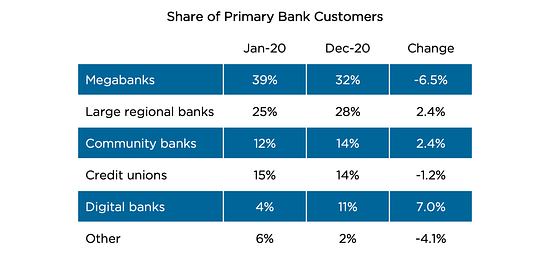
The banking industry sure is changing! There is now a slew of new banking service companies challenging the traditional banks giving them a run for their money. Aptly referred to as challenger banks, these new banking services offer a new dawn for the American consumer: low-cost or no-fee accounts, early access to wages, no overdraft fees, automated savings and more. What's more, many challenger banks aren’t actual banks but rather banking services that depend on other banks to facilitate their transactions. In fact, only a very small number of challenger banks actually have bank charters in hand—Varo, Marcus and Ally are a few that come to mind. Just don't expect their local branches to pop up any time soon! Mainstreaming of all digital banking While the world went fully digital in 2020, challenger banks like Chime, Varo, Current, SoFi, Current, and Aspiration came out big winners attracting new consumers whose needs, simply put, weren’t met by traditional banks. Meanwhile, megabanks like Wells Fargo, Chase, and BofA all lost market share of primary bank customers in 2020.
And if you're wondering how challengers make money... the vast majority of them do so via interchange fees that merchants pay to banks when customers use their debit or credit cards. And beware, some also make a hefty buck charging out-of-network ATM fees. If you haven’t yet jumped on the challenger bank bandwagon, should you? If you’re not quite sure whether you want to open an account with a challenger bank, here is what it boils down to: 🌟 Fees. If your current bank requires you to maintain a minimum deposit, or you're paying high overdraft fees and other bank charges, you should consider switching. Fees can creep and add up. In fact, the average US household pays $329 per year in bank fees alone. 🌟 Cash access. Many challenger banks allow you to get access to your wages two days early, and some others allow cash advances. Is this something you need now or think you'll need later? When pandemic lockdowns thurst millions of Americans into unemployment, quick and easy access to money became even more attractive. 🌟 Supporting a mission. Not all challenger banks support a higher cause, but some do. Aspiration, for example, offers socially-conscious and sustainable ways to spend or save money. How much does it matter to you to be mission-aligned with your bank or bank service? 🌟 Access to useful tools and features, like in-app budgeting, credit builder resources, auto-savings into customized buckets are just a few examples offered. If you use a separate paid budgeting app, you may be able to save yourself some money. One Finance and Empower are two challenger banks that come to mind offering budgeting tools within their app. Our take. The journey to modern, low-fee digital banking services has only just begun. According to Cornerstone Advisors, by the end of 2020, 15% of Gen Zers and Millennials considered a checking account from a challenger bank their primary account, up from 4% in Jan 2020. PRESENTED BY FUNDRISEThe 20% rule in investing. Only for the ultra-rich?
Investing experts will tell you that a 60% equity, 40% bond portfolio is how most investors should be allocated. Turns out this plain-vanilla strategy works fine for more of us since it's simple and manageable. But what if you tweaked your investment portfolio to add at least 20% toward alternative investments, an asset class with little or no correlation with traditional, publicly-traded assets? Why we’re talking about the 20% ruleCreated by the Chief Investment Officer of the Yale Endowment, David Swensen, the 20% rule is a diversification strategy that aims to reduce portfolio risk and in turn maximize return potential by allocating at least 20% of an investment portfolio toward alternatives. These investments fall outside the scope of traditional investments because they are usually traded in private markets, an area not well known except to the likes of the ultra-wealthy. And according to an analysis of a 19-year period by Blackstone, investors who diversified into real estate following this "20% rule" have historically outperformed those who didn't. That’s where Fundrise comes inPrivate real estate investing has traditionally been the playground for the rich, but Fundrise brings you: 🏠 accessibility—invest with as little as $500 🏠 durability—they’re all about long-term investing 🏠 technology—the platform is intuitive and easy Make 2021 the year you diversify your portfolio. Explore Fundrise. (Here are all the legal disclosures we know you'll love reading.) TAXESTax tips to help you prepare for April 15
2021 tax filing season has begun! While the IRS delayed last year's tax deadline, it's not expected this year. So, mark your calendars for April 15th and review these quick tips to help you get started on the right foot. Check to see if you qualify for free filing Did you know that you may qualify to file your taxes online for free? The IRS has a free filing lookup tool and you can also check these free filing resources directly:
Determine whether you'll be taking the standard deduction or itemizing Do this early in the process to help you determine whether you need to round up supporting documentation for itemized deductions. For many households, the biggest-ticket deductible items include state and local taxes (including property taxes), which are now capped at $10,000 per household, charitable deductions, home mortgage interest, and medical expenditures in excess of 10% of your adjusted gross income. If your itemized deductions total less than $12,400 for single or $24,800 for married couples filing jointly, you're better off with the standard deduction, which means fewer papers to get in order! Use a checklist to help you get organized Leverage a tax checklist to help you get organized and stay on track. If you're working with a tax preparer, share the checklist with them. Around this time of year, W-2s and 1099s, which report various types of income, are starting to roll in. If you don't have all of the 1099s you need, log in online to your provider's website to see if those are ready. Make IRA and HSA contributions as soon as possible Your deadline for contributing to an IRA or HSA for 2020 is on April 15, 2021. Don't wait until you get your taxes in to tackle those tasks. If you want to deduct your HSA or IRA contribution on your tax return for last year, you'll need to make that contribution before you file your return this year. Need a quick refresher? Take this quiz-based lesson to help jog some tax savings tips!
✨ TRENDING ON FINNY & BEYOND
How did you like The Gist today? (Click to vote) That’s it for today. If you’ve enjoyed today’s edition, please invite your friends to join Finny. Have a great rest of the week! The Finny Team
If you liked this post from Finny: The Gist, why not share it? © 2021 FinnyNL Unsubscribe
|